• Talk I gave Feb. 17 at TP …

    So Yvon asked me to speak to what brings us here.

    Her question was, Why Are We Here?

    And the answer, I think, is because there’s no other place I can be.

    There was a time in my life when I thought that being smart and strong were enough, that being invulnerable and impervious were sustainable defenses. Now many people here may have no idea what I’m talking about, but somebody does. And they’re here, too, so they’ll understand this:

    I was wrong.

    Living fully is living in community.

    Nobody is strong enough to stand alone and weather life’s storms. Nobody is strong enough to make it alone through the inevitable night.

    And nobody’s smart enough, either. The collective smarts of this community are more intelligent than any one member. Sound crazy? There’s a book called The Wisdom of Crowds, by James Suroweicki, who writes for The New Yorker magazine, and in it he reports on a simple experiment: A jar full of jellybeans, and each person in the room takes a guess. How many
    jellybeans? Well, the truth is, most of us will be way off. But if you average out our responses, our collective answer will be closer than all but one or two of us. And if we do it over and over, the collective answer will always be within a few jellybeans. But the folks who land closest? They’ll change. The smarts are in the room, not in any one person’s head.

    In the example in the book, there were 850 jelly beans in the jar. The group’s collective guess, was 871. Only one person was closer.

    In another example, a submarine sank off the Eastern seaboard. It was out of communication when it sank, and nobody knew it’s exact location. The government, obviously, wanted to find it, and assembled a team of experts, led by a naval officer named John Craven. Nobody knew why the submarine sank, how fast it was moving at the time or how steeply it fell to the ocean
    floor. And yet, not knowing all this, the group’s collective estimate of the location was just 220 yards off. Not one member of the group selected the aggregate location.

    You all have heard how mutual funds that invest in the entire market, or index a specific section of the market, outperform the great majority of funds actively managed by a person or a small group of people. Again, the genius is in the market.

    Finally, do you remember the TV program Who Wants to Be a Millionaire? If you do, you remember that host Regis Philbin asked contestants a series of questions. If they did not know the answer, they could call a friend, call an expert, or query the studio audience. zWhich was the best option? You guessed it, the studio audience – which was correct more than 90 percent of
    the time; the so-called expert, 67 percent.

    It’s an interesting thought for a religious community. The value of diversity is that it allows for more data points, more perspectives. And yes, diversity comes in many flavors, as the kids said earlier. We need diversity of experience, of ethnicity, of height and weight and occupation. To me, it gets at the genius of the democratic process, which doesn’t always feel like genius.

    Certainly, sitting in a congregational meeting, “genius” is not always the first thought that comes to mind. BUT, BUT, after two years as president of the board here at Thomas Paine, I have a bedrock faith that a group, given enough information, a good process and some time to think through the question, will come up with the wisest answer. It’s really kinda humbling.

    Now, this is not a request that this community make every decision communally. There is an inefficiency inherent in having everybody take part in every decision. That’s why you elect a board, and empower committees to do the community’s business. But it’s also why the community must grapple with and sign off on the decisions that set our collective direction. Because that’s how you get the best decision.

    So that’s why I’m here, because I need you. And because you need me, as well as all the other folks in the room. And in the bigger room.

    I don’t know if you have noticed, but there’s a presidential culling process going on right now, with at least four contenders still vying to become the President of the United States in a little less than a year. And one candidate speaks most eloquently to this need for community. Let me read from a speech he delivered in 2004, which echoes many of the UU principles that are important in understanding why I’m in this particular room, looking for your particular support:

    Tonight, we gather to affirm the greatness of our nation—not because of the height of our skyscrapers, or the power of our military, or the size of our economy. Our pride is based on a very simple premise, summed up in a declaration made over two hundred years ago: ‘We hold these truths to be self-evident, that all men are created equal. That they are endowed by their Creator with certain inalienable rights. That among these are life, liberty and the pursuit of happiness.’

    That is the true genius of America — a faith in simple dreams, an insistence on small miracles. That we can tuck in our children at night and know that they are fed and clothed and safe from harm. That we can say what we think, write what we think, without hearing a sudden knock on the door. That we can have an idea and start our own business without paying a bribe. That we can participate in the political process without fear of retribution, and that our votes will be counted at least, most of the time.

    This year, in this election, we are called to reaffirm our values and our commitments, to hold them against a hard reality and see how we are measuring up, to the legacy of our forebearers, and the promise of future generations. …

    If there is a child on the south side of Chicago who can’t read, that matters to me, even if it’s not my child. If there’s a senior citizen somewhere who can’t pay for their prescription drugs, and has to choose between medicine and the rent, that makes my life poorer, even if it’s not my grandparent. If there’s an Arab American family being rounded up without benefit of an attorney or due process, that threatens my civil liberties.

    It is that fundamental belief, it is that fundamental belief – I am my brother’s keeper, I am my sister’s keeper – that makes this country work. It’s what allows us to pursue our individual dreams and yet still come together as one American family.

    E pluribus unum. Out of many, one.

    Out of many, one. That’s why I’m here. I submit it’s why you’re here, too. So let us weave our collective experiences into the wisdom that only grows out of our frank, full and loving interaction. Blessed be.

  • This is from January 2007, during a service on the Roman god Janus and the spirit of change …

    —-

    I don’t know about you, but when asked to speak in public I will entertain ideas, consider ways in and out of the topic. If you’re unfortunate enough to live with me, you’ll even have to listen to me do this out loud.

    So when Virginia asked me to say something about change and this time of year when the past and future meet, I noticed that my thoughts turned toward some helpful aphorisms, a few tips about how to handle change. A sort of rah-rah talk: Life takes its best shot at us, but we can overcome it, we can win, if you will. It just takes a mindset, a toughness, a posture of thinking and being.

    And I was surprised, because, truthfully, that’s not my take on change. There’s a prayer that gets much closer, that is associated with people facing desperate change but that resonates with me universally.

    “God grant us the serenity to accept the things we cannot change,
    courage to change the things we can,
    and wisdom to know the difference.”

    Some change is personal and directed. I changed jobs recently. I absolutely meant to, it happened and I’m thankful. Here at Thomas Paine, look around you, we’ve changed – with hard work, some joy and a little pain. More power to all of us and our ability to effect change.

    But that kind of change is in the minority, I think. Most change is beyond our control. It is impersonal. It is neither enemy not friend. It simply is. Change – with a bang – ushered in existence. The end of change will mark the death of that existence.

    Change doesn’t care if I’m up for it or not. Change is a wave that will break across my bow over and over again.

    And while, at 42, I still cling to a certain cloak of invincibility, here’s a truth I know: change can break me, like a boat in high seas. In fact, change will break me. And it will break you. There will come a time when life will give us more than we can bear alone.

    Virginia and I learned a little about impersonal change this year. At the tail end of a pleasant vacation, change whacked us like a 2-by-4 to the side of the head.

    Kelly, one of our two heretofore perfectly healthy kids, was in the hospital, severely anemic, with a bloody colon and no real good answer as to why. This wasn’t change we welcomed, nor anything that we had any real control over. And so we spent six long days in a hospital.

    And I learned a couple things:

    • That my back, especially, doesn’t like sleeping on benches, But I can do it.
    • That I had a certain chauvinism about my healthy kids, a false pride that I had no right to—and correspondingly, a whiff of superiority regarding families where the kids had illnesses. It was one of the uncomfortable realizations of the year.
    • That I love my son with a depth and doggedness that I’d assumed but that isn’t always apparent in the normal day-to-dayness of life. And that I could not stop his suffering.
    • That Virginia and Peter and Kelly and I are blessed with so many people that care for us that it boggles the mind – and the heart.
    • That I believed it would all turn out alright.

    Now, four months later, it has and it hasn’t.

    Kelly is home and pretty much the kid he’s always been – the Charlie Browniest in the whole world. (I loved that line from the holiday pageant earlier this month.) And he most likely has Crohn’s Disease, he’ll most likely battle it his entire life, it will be unpleasant at times. It could cause him pain. He might need surgery. It might keep him from doing things that he otherwise might have done.

    And, somehow, and I know this is a little crazy, it’ll turn out alright. Because that, I believe, is how it happens – first, you must imagine it. That is the irrational magic of the world.

    And how do I reconcile that against the reality of impersonal change? I don’t know and, to a degree, I don’t care.

    So, Janus, who looks back and looks forward, is a great god for this time of year, when we take stock of where we’ve been and where we’re going. But me, when I look back, I realize that my challenge is to look right in front of me, right here and right now. That is where I must meet change – on the front lines, as it happens, in the moment. Too often I’m everywhere but where I am. It’s pervasive: These things – and the gadgets our kids huddle over for hours each day – I’m not suggesting we lose them, just that we realize they are obstacles to being present.

    So …

    When I am with Kelly in the hospital and he is suffering, be there. When my wife needs my counsel or my sympathy or merely a wisecrack, be there. When a friend is moving, help. When I’m here, be here.

    And, this is a hard one for guys, allow others to be here for me. Because isn’t that why we’re here? Because we know that truth about change – that we’re not up to it alone, that we can’t do it by ourselves, that we need communities of love and support.

    That’s the bedrock of my faith life. It’s why I’m here. So my hope for the new year is that we are there for each other. Blessed be.

  • This is from January 2007, during a service on the Roman god Janus and the spirit of change …

    —-

    I don’t know about you, but when asked to speak in public I will entertain ideas, consider ways in and out of the topic. If you’re unfortunate enough to live with me, you’ll even have to listen to me do this out loud.

    So when Virginia asked me to say something about change and this time of year when the past and future meet, I noticed that my thoughts turned toward some helpful aphorisms, a few tips about how to handle change. A sort of rah-rah talk: Life takes its best shot at us, but we can overcome it, we can win, if you will. It just takes a mindset, a toughness, a posture of thinking and being.

    And I was surprised, because, truthfully, that’s not my take on change. There’s a prayer that gets much closer, that is associated with people facing desperate change but that resonates with me universally.

     God grant us the serenity to accept the things we cannot change,
    courage to change the things we can,
    and wisdom to know the difference.

    Some change is personal and directed. I changed jobs recently. I absolutely meant to, it happened and I’m thankful. Here at Thomas Paine, look around you, we’ve changed—with hard work, some joy and a little pain. More power to all of us and our ability to effect change.

    But that kind of change is in the minority, I think. Most change is beyond our control. It is impersonal. It is neither enemy nor friend. It simply is. Change—with a bang—ushered in existence. The end of change will mark the death of that existence.

    Change doesn’t care if I’m up for it or not. Change is a wave that will break across my bow over and over again.

    And while, at 42, I still cling to a certain cloak of invincibility, here’s a truth I know: change can break me, like a boat in high seas. In fact, change will break me. And it will break you. There will come a time when life will give us more than we can bear alone.

    Virginia and I learned a little about impersonal change this year. At the tail end of a pleasant vacation, change whacked us like a 2-by-4 to the side of the head.

    Kelly, one of our two heretofore perfectly healthy kids, was in the hospital, severely anemic, with a bloody colon and no real good answer as to why. This wasn’t change we welcomed, nor anything that we had any real control over. And so we spent six long days in a hospital.

    And I learned a couple things:

    • That my back, especially, doesn’t like sleeping on benches, But I can do it.
    • That I had a certain chauvinism about my healthy kids, a false pride that I had no right to—and correspondingly, a whiff of superiority regarding families where the kids had illnesses. It was one of the uncomfortable realizations of the year.
    • That I love my son with a depth and doggedness that I’d assumed but that isn’t always apparent in the normal day-to-dayness of life. And that I could not stop his suffering.
    • That Virginia and Peter and Kelly and I are blessed with so many people that care for us that it boggles the mind—and the heart.
    • That I believed it would all turn out alright.

    Now, four months later, it has and it hasn’t.

    Kelly is home and pretty much the kid he’s always been—the Charlie Browniest in the whole world. (I loved that line from the holiday pageant earlier this month.) And he most likely has Crohn’s Disease, he’ll most likely battle it his entire life, it will be unpleasant at times. It could cause him pain. He might need surgery. It might keep him from doing things that he otherwise might have done.

    And, somehow, and I know this is a little crazy, it’ll turn out alright. Because that, I believe, is how it happens—first, you must imagine it. That is the irrational magic of the world.

    And how do I reconcile that against the reality of impersonal change? I don’t know and, to a degree, I don’t care.

    So, Janus, who looks back and looks forward, is a great god for this time of year, when we take stock of where we’ve been and where we’re going. But me, when I look back, I realize that my challenge is to look right in front of me, right here and right now. That is where I must meet change – on the front lines, as it happens, in the moment. Too often I’m everywhere but where I am. It’s pervasive: These things – and the gadgets our kids huddle over for hours each day – I’m not suggesting we lose them, just that we realize they are obstacles to being present.

    So …

    When I am with Kelly in the hospital and he is suffering, be there. When my wife needs my counsel or my sympathy or merely a wisecrack, be there. When a friend is moving, help. When I’m here, be here.

    And, this is a hard one for guys, allow others to be here for me. Because isn’t that why we’re here? Because we know that truth about change – that we’re not up to it alone, that we can’t do it by ourselves, that we need communities of love and support.

    That’s the bedrock of my faith life. It’s why I’m here. So my hope for the new year is that we are there for each other. Blessed be.

  • Talk I gave Feb. 17 at TP …

    So Yvon asked me to speak to what brings us here.

    Her question was, Why Are We Here?

    And the answer, I think, is because there’s no other place I can be.

    There was a time in my life when I thought that being smart and strong were enough, that being invulnerable and impervious were sustainable defenses. Now many people here may have no idea what I’m talking about, but somebody does. And they’re here, too, so they’ll understand this:

    I was wrong.

    Living fully is living in community.

    Nobody is strong enough to stand alone and weather life’s storms. Nobody is strong enough to make it alone through the inevitable night.

    And nobody’s smart enough, either. The collective smarts of this community are more intelligent than any one member. Sound crazy? There’s a book called The Wisdom of Crowds, by James Suroweicki, who writes for The New Yorker magazine, and in it he reports on a simple experiment: A jar full of jellybeans, and each person in the room takes a guess. How many
    jellybeans? Well, the truth is, most of us will be way off. But if you average out our responses, our collective answer will be closer than all but one or two of us. And if we do it over and over, the collective answer will always be within a few jellybeans. But the folks who land closest? They’ll change. The smarts are in the room, not in any one person’s head.

    In the example in the book, there were 850 jelly beans in the jar. The group’s collective guess, was 871. Only one person was closer.

    In another example, a submarine sank off the Eastern seaboard. It was out of communication when it sank, and nobody knew it’s exact location. The government, obviously, wanted to find it, and assembled a team of experts, led by a naval officer named John Craven. Nobody knew why the submarine sank, how fast it was moving at the time or how steeply it fell to the ocean
    floor. And yet, not knowing all this, the group’s collective estimate of the location was just 220 yards off. Not one member of the group selected the aggregate location.

    You all have heard how mutual funds that invest in the entire market, or index a specific section of the market, outperform the great majority of funds actively managed by a person or a small group of people. Again, the genius is in the market.

    Finally, do you remember the TV program Who Wants to Be a Millionaire? If you do, you remember that host Regis Philbin asked contestants a series of questions. If they did not know the answer, they could call a friend, call an expert, or query the studio audience. zWhich was the best option? You guessed it, the studio audience – which was correct more than 90 percent of
    the time; the so-called expert, 67 percent.

    It’s an interesting thought for a religious community. The value of diversity is that it allows for more data points, more perspectives. And yes, diversity comes in many flavors, as the kids said earlier. We need diversity of experience, of ethnicity, of height and weight and occupation. To me, it gets at the genius of the democratic process, which doesn’t always feel like genius.

    Certainly, sitting in a congregational meeting, “genius” is not always the first thought that comes to mind. BUT, BUT, after two years as president of the board here at Thomas Paine, I have a bedrock faith that a group, given enough information, a good process and some time to think through the question, will come up with the wisest answer. It’s really kinda humbling.

    Now, this is not a request that this community make every decision communally. There is an inefficiency inherent in having everybody take part in every decision. That’s why you elect a board, and empower committees to do the community’s business. But it’s also why the community must grapple with and sign off on the decisions that set our collective direction. Because that’s how you get the best decision.

    So that’s why I’m here, because I need you. And because you need me, as well as all the other folks in the room. And in the bigger room.

    I don’t know if you have noticed, but there’s a presidential culling process going on right now, with at least four contenders still vying to become the President of the United States in a little less than a year. And one candidate speaks most eloquently to this need for community. Let me read from a speech he delivered in 2004, which echoes many of the UU principles that are important in understanding why I’m in this particular room, looking for your particular support:

    Tonight, we gather to affirm the greatness of our nation—not because of the height of our skyscrapers, or the power of our military, or the size of our economy. Our pride is based on a very simple premise, summed up in a declaration made over two hundred years ago: ‘We hold these truths to be self-evident, that all men are created equal. That they are endowed by their Creator with certain inalienable rights. That among these are life, liberty and the pursuit of happiness.’

    That is the true genius of America — a faith in simple dreams, an insistence on small miracles. That we can tuck in our children at night and know that they are fed and clothed and safe from harm. That we can say what we think, write what we think, without hearing a sudden knock on the door. That we can have an idea and start our own business without paying a bribe. That we can participate in the political process without fear of retribution, and that our votes will be counted at least, most of the time.

    This year, in this election, we are called to reaffirm our values and our commitments, to hold them against a hard reality and see how we are measuring up, to the legacy of our forebearers, and the promise of future generations. …

    If there is a child on the south side of Chicago who can’t read, that matters to me, even if it’s not my child. If there’s a senior citizen somewhere who can’t pay for their prescription drugs, and has to choose between medicine and the rent, that makes my life poorer, even if it’s not my grandparent. If there’s an Arab American family being rounded up without benefit of an attorney or due process, that threatens my civil liberties.

    It is that fundamental belief, it is that fundamental belief – I am my brother’s keeper, I am my sister’s keeper – that makes this country work. It’s what allows us to pursue our individual dreams and yet still come together as one American family.

    E pluribus unum. Out of many, one.

    Out of many, one. That’s why I’m here. I submit it’s why you’re here, too. So let us weave our collective experiences into the wisdom that only grows out of our frank, full and loving interaction. Blessed be.

  • Hanging With Janus

    This is from January 2007, during a service on the Roman god Janus and the spirit of change …

    —-

    I don’t know about you, but when asked to speak in public I will entertain ideas, consider ways in and out of the topic. If you’re unfortunate enough to live with me, you’ll even have to listen to me do this out loud.

    So when Virginia asked me to say something about change and this time of year when the past and future meet, I noticed that my thoughts turned toward some helpful aphorisms, a few tips about how to handle change. A sort of rah-rah talk: Life takes its best shot at us, but we can overcome it, we can win, if you will. It just takes a mindset, a toughness, a posture of thinking and being.

    And I was surprised, because, truthfully, that’s not my take on change. There’s a prayer that gets much closer, that is associated with people facing desperate change but that resonates with me universally.

    “God grant us the serenity to accept the things we cannot change,
    courage to change the things we can,
    and wisdom to know the difference.”

    Some change is personal and directed. I changed jobs recently. I absolutely meant to, it happened and I’m thankful. Here at Thomas Paine, look around you, we’ve changed—with hard work, some joy and a little pain. More power to all of us and our ability to effect change.

    But that kind of change is in the minority, I think. Most change is beyond our control. It is impersonal. It is neither enemy not friend. It simply is. Change—with a bang—ushered in existence. The end of change will mark the death of that existence.

    Change doesn’t care if I’m up for it or not. Change is a wave that will break across my bow over and over again.

    And while, at 42, I still cling to a certain cloak of invincibility, here’s a truth I know: change can break me, like a boat in high seas. In fact, change will break me. And it will break you. There will come a time when life will give us more than we can bear alone.

    Virginia and I learned a little about impersonal change this year. At the tail end of a pleasant vacation, change whacked us like a 2-by-4 to the side of the head.

    Kelly, one of our two heretofore perfectly healthy kids, was in the hospital, severely anemic, with a bloody colon and no real good answer as to why. This wasn’t change we welcomed, nor anything that we had any real control over. And so we spent six long days in a hospital.

    And I learned a couple things:

    • That my back, especially, doesn’t like sleeping on benches, But I can do it.
    • That I had a certain chauvinism about my healthy kids, a false pride that I had no right to – and correspondingly, a whiff of superiority regarding families where the kids had illnesses. It was one of the uncomfortable realizations of the year.
    • That I love my son with a depth and doggedness that I’d assumed but that isn’t always apparent in the normal day-to-dayness of life. And that I could not stop his suffering.
    • That Virginia and Peter and Kelly and I are blessed with so many people that care for us that it boggles the mind – and the heart.
    • That I believed it would all turn out alright.

    Now, four months later, it has and it hasn’t.

    Kelly is home and pretty much the kid he’s always been—the Charlie Browniest in the whole world. (I loved that line from the holiday pageant earlier this month.) And he most likely has Crohn’s Disease, he’ll most likely battle it his entire life, it will be unpleasant at times. It could cause him pain. He might need surgery. It might keep him from doing things that he otherwise might have done.

    And, somehow, and I know this is a little crazy, it’ll turn out alright. Because that, I believe, is how it happens—first, you must imagine it. That is the irrational magic of the world.

    And how do I reconcile that against the reality of impersonal change? I don’t know and, to a degree, I don’t care.

    So, Janus, who looks back and looks forward, is a great god for this time of year, when we take stock of where we’ve been and where we’re going. But me, when I look back, I realize that my challenge is to look right in front of me, right here and right now. That is where I must meet change—on the front lines, as it happens, in the moment. Too often I’m everywhere but where I am. It’s pervasive: These things – and the gadgets our kids huddle over for hours each day—I’m not suggesting we lose them, just that we realize they are obstacles to being present.

    So …

    When I am with Kelly in the hospital and he is suffering, be there. When my wife needs my counsel or my sympathy or merely a wisecrack, be there. When a friend is moving, help. When I’m here, be here.

    And, this is a hard one for guys, allow others to be here for me. Because isn’t that why we’re here? Because we know that truth about change—that we’re not up to it alone, that we can’t do it by ourselves, that we need communities of love and support.

    That’s the bedrock of my faith life. It’s why I’m here. So my hope for the new year is that we are there for each other. Blessed be.

  • Really fascinating presentation from the TED conference. Steven Pinker argues that violence is at a low point in human history. Watch it.

  • Media_httpfarm4static_bjcie

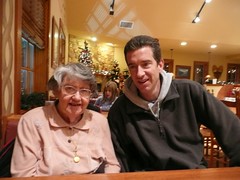
    Grammy and Uncle Chris
    Originally uploaded by kevdonahue

    We sent the Kirks back to Maryland with a stop at the local ice cream palace. Good visit, which included lotsof ping-pong, football, turkey, laughs – and we caught the newest Disney flick, Bolt, to boot (the early word – the kids loved it; the adults liked it – and Virginia got weepy about the pet-away-from-home line of the story).

    Anyway, it’s still only Saturday, and we’re getting in a last bit of fun before we head back to work and school on Monday.

  • Really fascinating presentation from the TED conference. Steven Pinker argues that violence is at a low point in human history. Watch it.


  • Grammy and Uncle Chris
    Originally uploaded by kevdonahue

    We sent the Kirks back to Maryland with a stop at the local ice cream palace. Good visit, which included lotsof ping-pong, football, turkey, laughs – and we caught the newest Disney flick, Bolt, to boot (the early word – the kids loved it; the adults liked it – and Virginia got weepy about the pet-away-from-home line of the story).

    Anyway, it’s still only Saturday, and we’re getting in a last bit of fun before we head back to work and school on Monday.


  • Grammy and Uncle Chris
    Originally uploaded by kevdonahue

    We sent the Kirks back to Maryland with a stop at the local ice cream palace. Good visit, which included lotsof ping-pong, football, turkey, laughs – and we caught the newest Disney flick, Bolt, to boot (the early word – the kids loved it; the adults liked it – and Virginia got weepy about the pet-away-from-home line of the story).

    Anyway, it’s still only Saturday, and we’re getting in a last bit of fun before we head back to work and school on Monday.

  • Media_httpfarm4static_lotwb

    P1030897.JPG
    Originally uploaded by kevdonahue

    This was Friday, actually, when the Kirks visited us, but the turkey, stuffed, mashed potatoes and veggies were flying, so it felt like T-giving for sure.

    The day before we spent in NJ with Kevin’s family – and saw Gail and Tommy from Wisconsin, which was a special treat.

    Peace and blessings to all!


  • P1030897.JPG
    Originally uploaded by kevdonahue

    This was Friday, actually, when the Kirks visited us, but the turkey, stuffed, mashed potatoes and veggies were flying, so it felt like T-giving for sure.

    The day before we spent in NJ with Kevin’s family – and saw Gail and Tommy from Wisconsin, which was a special treat.

    Peace and blessings to all!