• Why Seeing Marriage As a Series of One-Year Contracts Is a Good Thing

    It was the evening of our 24th anniversary and my wife and I were going through a familiar ritual.

    “You’re sticking around, right?” I asked.

    “I’m thinking about it,” she said.

    “But it’s almost 10 o’clock. You need to make a decision.”

    “I know.”

    Eventually she said sure, she’d re-up the vows we made in March 1992 to have and to hold, for better or worse. And I knew she would. Heck, she has for the 13 or 14 times since this bit of theater began.

    Except it’s not theater. It IS ritual — good ritual, even.

    Good ritual holds open a space, a possibility. That the candle will burn on. That a child has reached the cusp of adulthood. That a people will endure. That a baby is born into belonging.

    For us, the ritual holds open the possibility that we can be partners who square up to each other, who appreciate each other, who love each other — our strengths, our desires, our needs, our hurts, the hum-drum of our lives — clearly.

    Because that clear-headedness, and the intention to do that squaring, holds us together and keeps us honest. I’ll speak only for me in saying that it keeps me from taking Virginia for granted—most of the time.

    A life is a sprawling, multidimensional thing. It can pull us in many directions. Sometimes those directions take us down separate paths. And that’s OK—as long as there’s a coming together.

    In the best returnings, there is a sense of gifts brought back. Of a covenant reforged.

    So that’s why I like our contract-renewal ritual. Because the truth is, we do re-new our relationship every day, but on our anniversary most of all.

    It’s needed. At more than a few times throughout the year, we’re called apart (by the world, by our resentments and differences and egos, by our fears and sometimes even our hopes) and we come back together.

    There is no certainty in this world that we will always come back together. Partings are as much a part of this world as homecomings. We hear, and sometimes live, those stories.

    So I do celebrate when Virginia decides she’ll do this another time. And I got a huge kick from all the folks who reacted to our press release on Facebook.

    We negotiated late into the night, and I’m happy to announce that Virginia Kirk has signed on for another year of being married to me. We start on Year 25 today. I told her we could save a lot of time, and grant her a degree of contractual (if not financial) certainty, if she’d sign on for 4 or 5 more years. She prefers the annual option of restricted free agency.

    And so we’re a couple days into Year 25, winding our lives together and watching them work themselves apart. It is holy, dynamic work and I am grateful to have a partner willing to square up and love me through the rough spots of going-and-returning.

  • Why a Son Stranded at Night Resonated with So Many Friends

    I was dead asleep on a Monday night when the phone rang. I’d been asleep only an hour, but as I was startled awake, it felt like much longer. It was my oldest son calling to say that his car had died on the way home and he was stranded on the side of the Schuylkill Expressway. He was asking about how to call AAA. He hoped AAA would be able to jump-start his car and send him on his way.

    I confirmed with him how to call them, then sat there thinking. It was unlikely the car simply needed a jump. Eventually I got up and awaited the follow-up call.

    It came and we agreed the car should be towed to where it could be repaired, at the family mechanic’s place. We met there and were back home by 1:40 a.m. I went to sleep and the next morning I wrote this on Facebook.

    A midnight call from the oldest son that his car broke down on the Schuylkill Expressway is no fun.

    And yet, to see him manage a small crisis, to pick him up and drive home in the dark talking and excavating small truths, to return to bed, everyone safe (the tow truck driver even waited with Pete till I arrived where they took the car) confirms for me that this world is full of graces embedded in its difficulties, large and small.

    Grateful for this particular, small one. But a little tired too.

    And then people started to like it. It amazed me when it was liked by more than 120 people (and counting). I wonder why, and I think that in a Facebook feed dominated by eruptions against (and occasionally FOR) Donald Trump, something that is non-political and simply an acknowledgement of the challenges and rewards of this life struck people as real and valuable.

    And thank God for that.

    May your life be occupied by the real things—the care and concern we share for the ones we love. Our efforts to influence the things we can to make lives better—our lives, others’ lives. We are in this together.

  • Oscar Picks 2016, in About 2 Minutes

    Putting them down here, so I can’t claim to have been right if I was wrong.

    Best Actor: Leo DiCaprio. Overdue and deserved.

    Best Actress: Saoirse Ronan. Looking for an upset over Brie Larson here.

    Best Picture: The Revenant. I’d like to see Spotlight win, but I think the momentum of Leo and director will pull this overlong, over-somber film along.

    Best Director: Alejandro González Iñárritu.

    Supporting Actor: Sly Stallone, because it’s an uplifting story. The others were all good, too. Especially liked Mark Rylance in Bridge of Spies.

    Supporting Actress: Rooney Mara. She was wonderful in Carol.

    Animated Feature: Inside Out. The return of Pixar.

    Cinematography: The Revenant.

    Costume Design: Mad Max.

    Documentary: Amy.

    Film Editing: Mad Max.

    Foreign Language: Mustang. No idea, trusting others here.

    Original Score: Carol.

    Original Song: Till It Happens to You.

    Production Design: Mad Max.

    Sound: The Revenant.

    Adapted Screenplay: The Big Short.

    Original Screenplay: Spotlight, with Inside Out close behind.


  • Where Should I Put My Stuff?

    I’ve been circling Medium for about a year now. The self-proclaimed platform for thinkers and thoughtful discussion has a formidable back-end—it’s the best WYSIWYG editor I’ve seen, and it has the smartest commenting system I’ve seen.

    And there is plenty of content there, including posts from Hillary Clinton, Politico, Jeff Jarvis, and many others.

    But …

    But it has a real Silicon Valley/lifehack bias that I find stultifying. I could care less about VCs and 80 posts a day about the social implications of Slack. Please.

    Beyond that, it seems as if it’s very difficult for non-tech content to surface on the platform—stories about people who don’t live near San Jose and the Bay Area, about non-Silicon Valley ideas, about “8 Competitors for Slack” or “13 Thoughts about the Latest Java Update.”

    I’m not saying those aren’t valid topics—only that they don’t interest me and, I suspect, most people who live outside the tech-verse, which, admittedly, is a highly engaged and growing universe. Just not mine.

    I have a WordPress blog, hosted at WordPress.com. It’s simple, I like it. It receives very modest traffic. Nobody comments on the articles at all. All the conversation happens on Facebook and Twitter, which is fine. That makes me think I should post to Medium—except I don’t like giving up ownership of the things I think and write, especially to a platform that is at best indifferent and perhaps even hostile to my being discovered there. But Kevin, I tell myself, NO PLATFORM cares about you.

    That, alas, is most likely true.

    But WordPress is part of the open web, which I think is important, even in a world dominated by walled gardens and platforms like Facebook and Medium.

    So I think I will sit tight, for now. Come visit me here again.

  • 59 Photos from My Trip to Haiti

    Even though I’ve been back home for nearly a month, people I haven’t seen in a while keep asking how January’s service trip to Haiti was.

    My response is along the lines of “Do you want the 20-second version or the 9-hour version?”

    They think I’m kidding.

    I am and I’m not.

    Trying to explain the experience is hard.

    So let me run you through a bunch of photos and see if that helps to sharpen the story, and save us about 8 hours and 45 minutes. If you want to know more, click back to my earlier posts chronicling our stay (The Whirlwind Start, the Accident on the Road, the Departure and Homecoming), as well as some thoughts on the big lessons I brought home about education, agriculture, and power—and a poem, The Boy on the Road.

  • The Amazing Way Power Is Coming to Homes in Rural Haiti

    One of the amazing things I learned in Haiti happened in a little room located at the headquarters of the Papaye Peoples Movement (MPP). It was a workshop, actually, where a small team put together and repaired solar panels for use by peasants.

    The technicians told us that they have been doing this for several years, that they would prefer to use U.S.-manufactured parts but lower costs had driven them to use Chinese-made parts (they seemed quite afraid we would be offended by this—which would have been hard with a Chinese-manufactured iPhone in my back pocket).

    The units they created were mostly small. And the technicians told us that they couldn’t keep up with demand. In fact, they had taken to buying complete charging units from China rather than buying the parts and fabricating the units themselves (which they had done to keep costs down for the peasants).

    And why were these units so popular with the peasants?

    To power their cellphones, of course.

    It was another of those “raise palm of hand to forehead” moments. Of course, it was the cellphones changing people’s behavior. 

    For at least a decade, First World helpers have come to Haiti with solar stoves and other contraptions so the Haitian people could stop cooking with wood fires and preserve the forests. A noble goal, but one the Haitians had no interest in. “That’s not how we cook,” they’d say.

    But cellphones. People will do anything for their cellphones, even in the poorest country in the Western Hemisphere, even in the country’s Central Plateau, where annual household income is around $400. Like all those people splayed out in the aisle at the airport, phone cords wrapped all over the place to re-charge, Haitians are motivated by their phones.

    It’s not hard to imagine that people will buy the unit to charge the phone, then purchase a slightly larger one (with a small battery) to power a few LED bulbs at night. Soon they’ll have it power a small fan or a radio. And that is likely how Haiti will power itself into its next phase of development, one cellphone and one solar panel at a time, motivated by what Haitians want, and not what well-meaning First Worlders try to provide.

    And for the 473rd time on this trip, mind blown.

    (And if you thought solar was a long way from mattering in the First World, this is a fascinating piece from Vox that is really encouraging. It’s closer, and better, than you might think.)

  • This Windows (Phone) Is Sorta Broken—By Its Apps

    I tried out a Microsoft Lumia 830, which came out last year, with a FitBit Flex activity tracker.

    It’s a mixed bag. I like the Flex, though not as much as the Jawbone UP24 I had last year. The Jawbone was easier to get on and off, and it was simpler to integrate it with our activity tracking software (like Runkeeper and Map My Fitness). It had a really good app. The Jawbone also lasted 2 weeks on a charge; the Fitbit barely makes it 3 days.

    The larger disappointment is the Windows Phone. I actually like the Windows Phone OS. I think I could learn to use it as readily as I do my iPhone. The big screen (5 inches) was bright enough, and I’m not bothered by the plastic-ness—heck, I wrapped the plastic in a rubber case to make it easier to handle.

    No, the problems were:

    • The camera is very pedestrian, which is a problem when the iPhones and Galaxys all sport darn-near-amazing ones.
    • The apps are not even second rate. This weekend I attended a concert then traveled for a family function, so I put on the apps I would normally use to keep me functioning and in the know: Waze, Fitbit, Twitter, Facebook, ESPN, Instagram, Spotify, Ruzzle, Evernote, Audible. Three of them—Waze, Instagram, ESPN—had serious bugs. Waze required me to leave the app and return after setting a destination to remove a constant “calculating route” message that covered the functioning directions. ESPN and Instagram could not access scores and photos, respectively. Ruzzle worked, sorta, but was missing the popular 1-minute tournament mode and often didn’t display prompts to play a next round or start a new game.

    I pulled my SIM chip this morning and put it back in my iPhone. I just can’t handicap myself that badly by using a platform where 3 of the primary apps I needed were essentially unusable. I was willing to entertain an app environment that’s limited but usable; I wasn’t counting on limited and often non-functional.

    Maybe the new Lumias are better. Hope springs eternal. I like how Microsoft is bringing phones and PCs together in different ways than Apple. But the environment needs to mature in a hurry. Or maybe, it’s on to the Surface Phone.

  • The Bones In My Brain

    A poem about the fragility of my attention.

    Brains have bones.
    That’s dumb, right?
    Except—how else
    to explain the form

    of my thoughts,
    the broken-ness of
    my attention?

    It explains a lot,
    how goddamn lost
    I get in this head,
    to learn that I broke
    the bones in my brain.

    The bones in my brain
    give shape to my thoughts.
    They stitch a matrix
    of feeling to experience,
    of idea to intuition.

    The bones in my brain
    are apt to snap.
    What a wonder
    they reset so quickly!

    My wife told me
    “Brains have bones”
    one recent morning
    and when I stopped

    chuckling, I thought:
    bones in my brain, yes.

  • The Boy on the Road

    A poem I wrote after our scary Wednesday in Haiti.

    The boy lies limp in the dust
    Of the road. An argument engulfs him.

    The boy’s Papa screams, “Who did this?
    What have you done to my boy?”

    But no one helps the boy.

    Ayiti lies on the road under a midday sun,
    Blood from her head, her shoes
    Knocked from her feet.
    But the crowd does not tend to Ayiti.
    The crowd argues over why Ayiti was on the road.
    The crowd jostles who will pay for the blood.

    The crowd roars, “The boy is dumb.
    Why was he on the road?” The father,
    spits fury at the motorbike rider,
    “How could you be so careless?!?
    I cannot pay for the hospital!
    All I have is my anger!”

    And still, who will care for the boy on the road?

    Ayiti lives her life on the road,
    Her blood mixes with the dust
    And becomes one. And what does
    It mean, then, when the dust
    Rises and coats every person and
    Every place? What does it mean
    That the boy’s blood mixes
    With the dust and rises and coats
    Every person and every place
    Along the road?

    Ayiti lies on the road under the midday sun.

    Who will care for the boy on the road?

    This is one in a series of posts chronicling my experience of and response to a recent service trip to Haiti.

  • A Different Take on Education

    There were several times in my time in Haiti when I felt like the world as I had known it was turned upside down.

    One of those came on Monday, when the current director of the Papaye Peasant Movement visited with us and explained his group’s take on education, specifically adult education.

    This is one in a series of posts chronicling my experience of and response to a recent service trip to Haiti.

    MPP calls it Popular Education, and it’s the opposite of sitting in a classroom and absorbing lessons. In many ways, it’s a reaction to the Duvalier dictatorships, which didn’t want the peasants to be educated, so there couldn’t be formal school learning.

    Instead, MPP’s organizers, called “animators,” would arrive in a community and teach while the peasants worked. The lessons were not out of a book. They were shared orally, and the peasants would listen, ask questions, and return the next day to further engage the subject. Over three months, the animator would “teach” 6 major themes. At the end of that time, the student/peasants could decide to organize into a “groupment.” This is the foundation of MPP’s organization. Today, there are more than 4,500 groupments, comprised of roughly 61,000 people, spread across the country.

    The six themes aren’t subjects like English or Trigonometry (and many thanks to trip participant Leslie Runnels for taking—and sharing—such excellent notes). They are:

    • 1st Theme: Love, Friendship, and Friends.
    • 2nd Theme: One Body. Union & Strength.
    • 3rd Theme. Patience. (There is an old Creole saying: Are you patient enough to see the guts of an ant? Haiti requires patience of the ant-guts variety.)
    • 4th Theme: History, including a significant amount of Haitian history (in discussing, the MPP director pointed out that the lessons expose “today’s slavery” and show today’s peasants that they aren’t really “free and independent,” despite what they are told by the government and media).
    • 5th Theme: Self-Worth and Value. Among the subjects addressed: the value of people, even when not working; how to help each other and maintain solidarity; how church and other social communities matter; and how to invest and re-invest, and keep working together.
    • 6th Theme: Division & Reconciliation.

    The six themes and the method of instruction struck me as profoundly different from my conception of what education is. In Haiti, with MPP, education is essentially relational. It is about how we get along. In the U.S., in my experience, education is intellectual and personal. It is about what I know and what I do with it.

    I thought about this against the backdrop of many data points that argue that the United States is a lonelier and more self-centered country than it has been over its history (though don’t get too carried away here, this is a matter of degree), and this vision of education that is about and for establishing the Commons is very appealing. While I wouldn’t want my kids to receive only an MPP-style education, there is much I can learn and honor in MPP’s effort to value community and right relationships as foundational to developing as people.

    And once again, when I don’t view my experiences in Haiti and the U.S. as polarities, but as expressions of our shared values, I can begin to make sense of it. And that, in one sense, is the point of this kind of travel.

  • Why Haitians Reject Industrial Farming

    One of the most interesting parts of our stay with the Papaye Peasant Movement (MPP), in Haiti’s Central Plateau, was the group’s principled take on agriculture.

    As a child of industrial agriculture (and also as an employee of a company that publishes Organic Life magazine and whose founder, J.I. Rodale, started the organic movement), it was fascinating to hear MPP’s critique of it. At the same time, it was hard to wrap my head around their complete dismissal of it.

    The critique is pretty simple: industrial agriculture is dependent on non-natural products (chemical fertilizers, large machinery, oil, GMO and productized seeds) and practices that, if allowed, would exploit the rural peasants of Haiti. It’s unsustainable, not in its yields but in its impact on the planet. And it takes away independence and food sovereignty from native people.

    All that is true. And at the same time, industrial agriculture allows for most people to not be full-time or primarily farmers and instead to diversify what people do. Even a couple hours last week were enough to convince me that I was uninterested in devoting 4-6 hours daily to raising my own food. And even if I was, I don’t think enough of the industrialized world is going to be willing to retrace its steps in that way.

    So I don’t see Americans moving to MPP’s model any more than the other way around.

    And that’s fine, I think. This is not a binary problem; it’s not one way or the other. The answer is a middle way, or hundreds, maybe thousands or tens of thousands of middle ways, that maintain heightened yields while containing the environmental impact and respecting people’s rights to self-determination and food sovereignty.

    The middle way lies between Haiti and the U.S. mainland. I set my intention to being open to the middle way.


  • #3: Homecoming

    It was the lights of Miami that told me our trip was over. The lights I didn’t take for granted, and that seemed so abundant—excessive and wasteful, even—after a week spent in Haiti’s Central Plateau.

    The plane ride allowed for some time to take stock of the past three days. None had the emotional rawness of Wednesday, but they continued the work of understanding this place and its people—and made me aware of how much I have to learn and experience.

    This is the third of three posts sharing this service trip to Haiti.

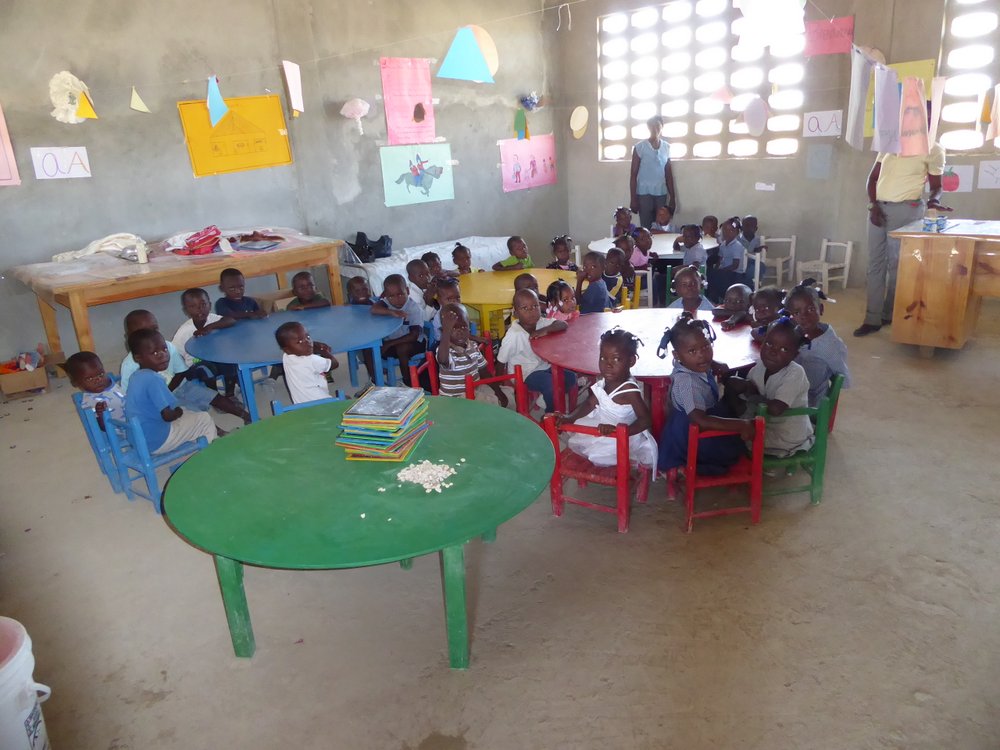
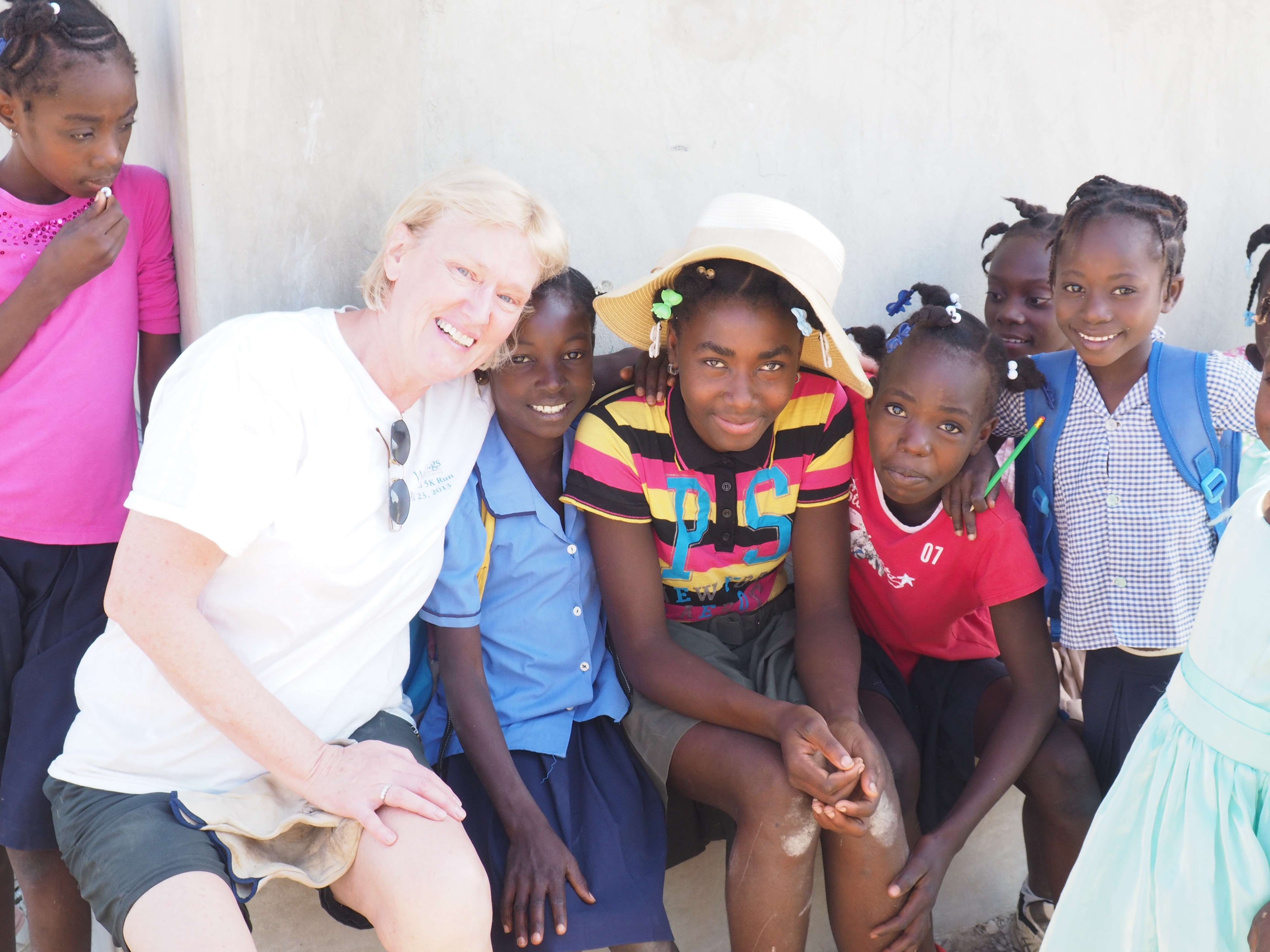
    On Thursday, we returned to the school to clean up more rocks for a playground, and played soccer and took photos with the students at recess. After recess, we visited each classroom. In one classroom were four impossibly low tables and tiny chairs, each with a group of 2-, 3-, 4-, and 5-year-olds, respectively, sitting around it. We sang “Old MacDonald” for them, after they provided an animal for each verse.

    25-P1010067
    We visited this classroom with one table each of 2-, 3-, 4-, and 5-year-olds, at impossibly low tables. Joy!

    Other classes sang for us and made room for us to sit with them. The school’s director shared that the school, which was expanded last year, would like to accommodate more older children and asked for our help.

    That afternoon, we visited the Bassin Zim waterfall, where young people (mostly boys) scrapped to be our guides along the falls and secure a $1 tip. It was as uncomfortable as that sounds. In the evening, a local dance troupe visited the MPP compound to perform.

    Charlot with students at recess.
    34-P1010136
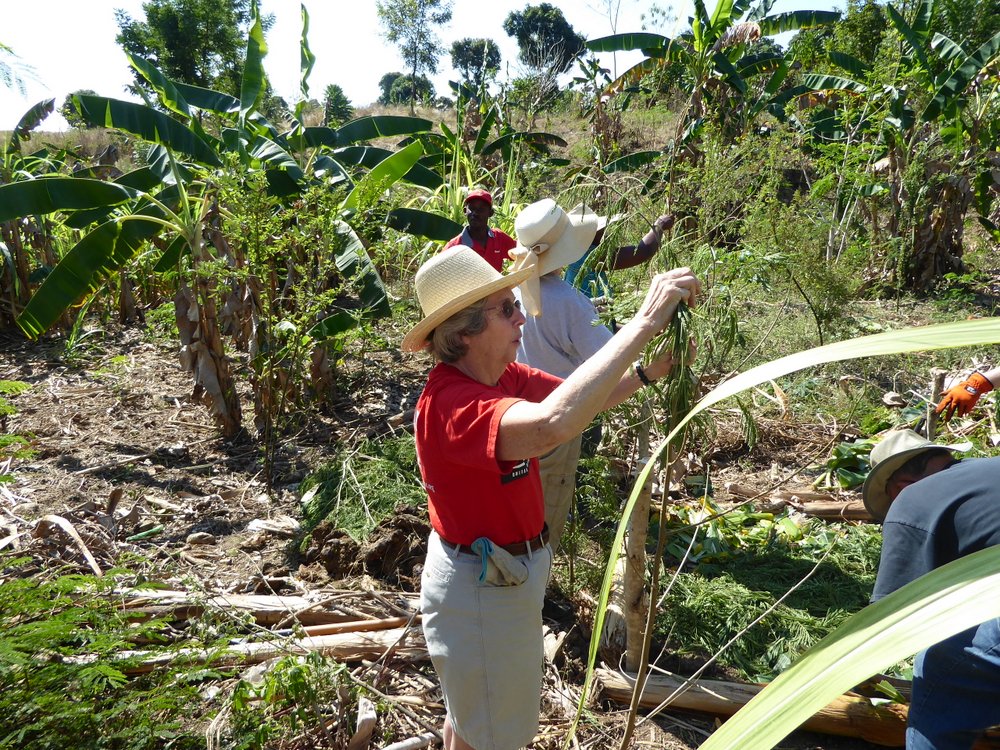
    Here we’re cutting material to make a compost pile at Eco Village 1.

    Friday, we visited Eco Village 1, the oldest of the villages constructed to offer refugees left homeless by the earthquake not just a home but a sustainable way of life.  (This is the village that members of Main Line Unitarian Church helped construct on the first service trip to Haiti three years ago.) While there, we learned how to compost, MPP-style. As when we made natural insecticides with MPP instruction two days earlier, I was struck by how much work goes into sustainable agriculture in the Central Plateau.

    That afternoon, we met with the leader of the Women’s Groupment, who shared the group’s work in combating domestic violence. MPP is progressive in its commitment to gender equality, and it backs its talk with actions: during our time in Haiti, I was struck by how many smart, capable women served in positions of leadership at MPP. That includes our handler, Marguerite, who deftly guided us through Wednesday’s craziness and the entire week.

    We then met with MPP’s former head and charismatic founder, Jean-Baptiste Chavannes. In a free-wheeling, laughter-filled two hours, Chavannes shared many stories, including how he got his start as a social justice warrior (he went to police to complain that a local political leader had stolen his uncle’s cow and, against all odds, retrieved it and had the official arrested and imprisoned).

    IMG_8652

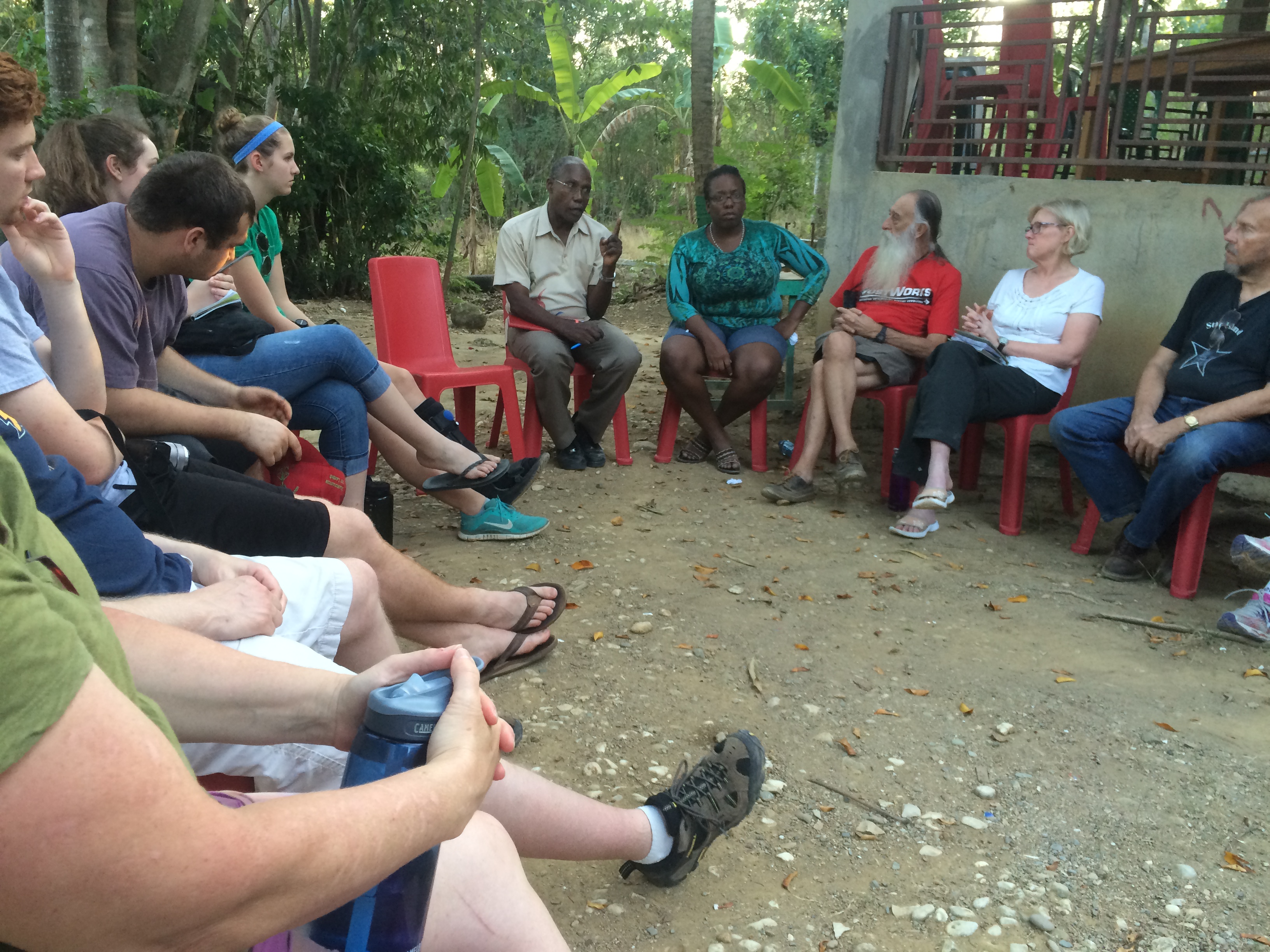
    That night we had our final reflection of the trip, and each person shared an object or words. A dress, several quotes, a camera, stones from places we visited, a ukelele, a machete, the covenant that guided the group through the experience. I shared this little poem:

    Haiti is not just a country.
    It is that setting in Google Photos
    Called Vibrance or something
    Equally strange, that when
    You move it to the right
    It makes your photo burst
    With color; What looked
    Ordinary takes on a strange,
    Enhanced quality. The greens
    get greener, the details appear
    In the shadows—surprise! They were
    Always there. And I sit here
    Looking at this moment we share,
    The Haiti filter on, and I say,
    “We will share this forever.
    Let us gaze on this image
    And feel the heat and the heart,
    The connection and its breaking,
    And know that this time, this place,
    This image, these people, these feelings,
    They are not an effect.

    This is life, lived from a deep place
    Of love, and fear, and hope.
    And as we part, please,
    Do not adjust the settings.”

    DSC09639
    On the final night, we created a circle and each put what we wanted inside it. That’s my notebook …

    Saturday was the long road from Central Plateau to Port-au-Prince, to a tchotchke shop, to the airport, to Miami, to Philly. It’s 15 minutes till touchdown. I am tired, but incredibly moved by the people we met, the beauty and joy and heartbreak and sheer unexpectedness of Haiti, and the deep ties formed within the group itself. If this was service work, I pray it benefited those I met for the first time, and the thousandth time. I too have been served. Now it’s time to serve up some shuteye.

    DSC09412
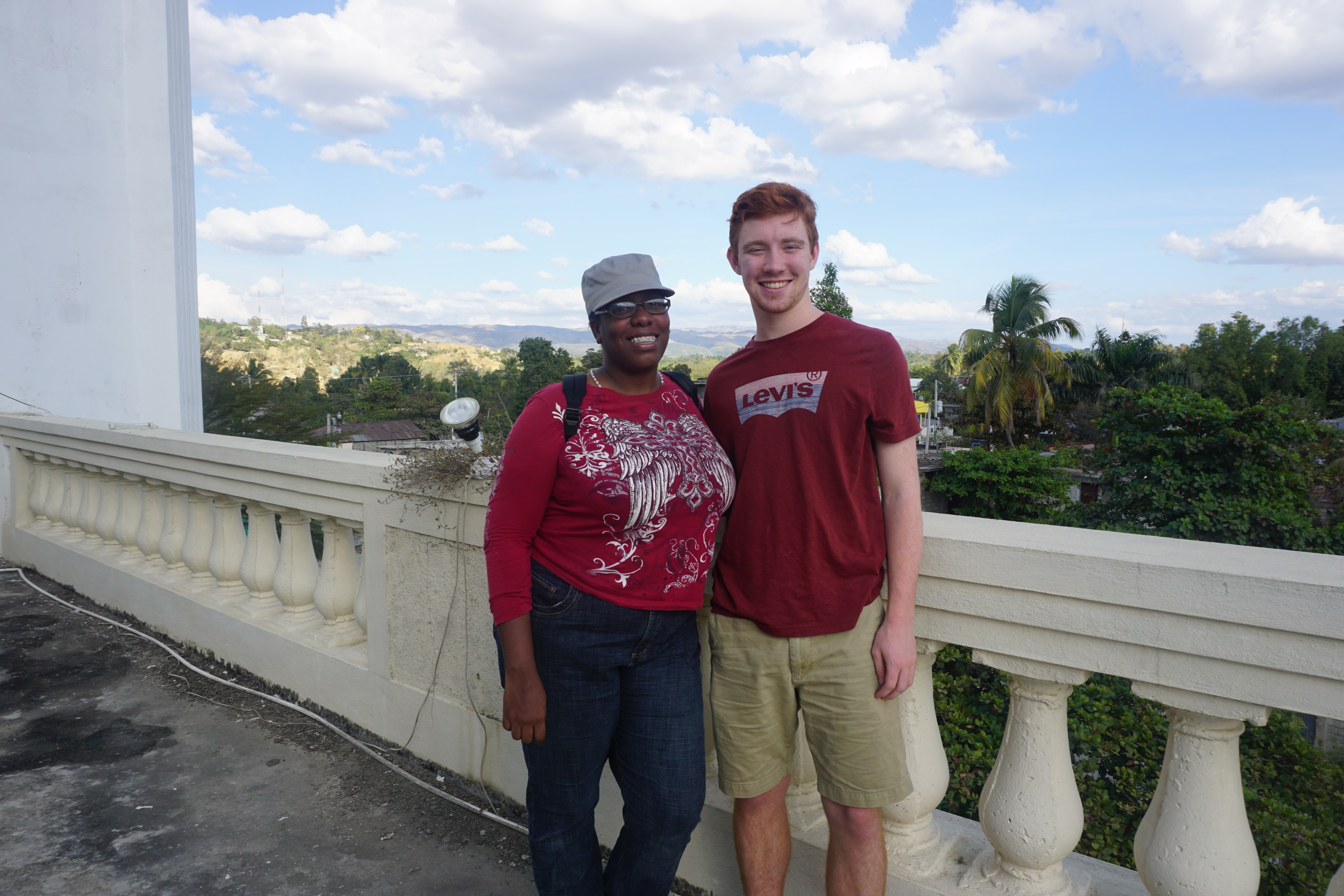
    Kelly with translator Majeeda atop the Catholic church in Hinche.