• New Year, New Start

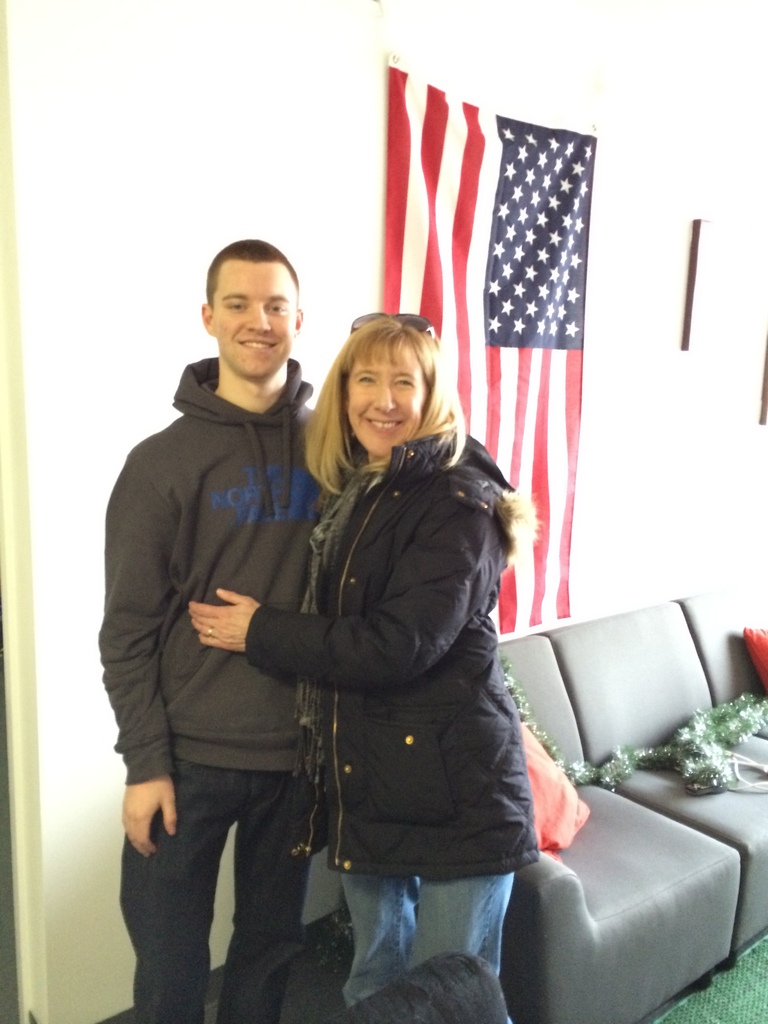
    We dropped Pete off at college Saturday. This time, it was at Temple University.

    Temple was Pete’s first choice coming out of high school, but he just missed being accepted then. He transferred after the fall semester of his sophomore year, and will pick up his studies at Temple’s School of Tourism and Hospitality Management.

    He’ll be living in Morgan Hall, which is not your typical dorm. It’s beautiful (check out the photos) and answers the primary objection of parents to Temple over the years—a lack of on-campus housing.

  • Our Home Base in Haiti

    Here’s a Bubble of the front of the dorm at the MPP compound outside Hinche, Haiti.

    Front of building (bubb.li)

  • 17 Pilgrims, a Poem

    Editor’s note: Something I started writing when I awoke very early one morning in Haiti’s Central Plateau, trapped between my mosquito net and my racing thoughts.

    17 Pilgrims

    Seventeen pilgrims on the road from Port-au-Prince to the Central Plateau.

    Haiti is life lived on the road, in full view.

    It is a hot, dusty iceberg. The mystery resides in the heat and the dirt.

    The water is there, but ― did I mention? ― don’t drink it.

    Haiti is a mystery wrapped in an enigma wrapped in a plantain husk.

    It is a mosquito buzz at midnight.

    It is the fear your net is tattered.

    Haiti is a heart pumping in the hot sun.

    It is families separated.

    It is drums in the night.

    Haiti is the roosters who practice dawn all night long, it is the cries of ya-ya-ya that dance with the drums in the night.

    ///

    Haiti, I met you just a week ago. I’m not sure my mom would approve. I’m not sure I approve. I doubt this will last.

    But I thought that about my wife of 22 years. As then, I’m intrigued.

    ///

    Haiti, you are a Dickens novel with a Kreyol accent, a plume of dust rising from a single road to fill every nook and cranny of every home in an entire country.

    You are life lived on the road and drums in the night. You are a geography of risk. You are a rich man’s house hard by a tent city.

    Haiti, you trudge to the end of a long day. I expect you to wake tired in the morning. Instead, you are bright smiles.

    Haiti, the sound of your yearning excruciates. It is the sound a dump truck makes as it tips over with a load of rock, the sound of a hungry child looking to you for food.

    I landed in Haiti an adult. I leave an awkward adolescent, upset with my frustrated wants.

    Haiti is not solved. Rather, it dis-solves.

    Reach for certainty in Haiti and it is gone.

    Haiti is a parent’s children settled in the States. It is drums in the night. From where are they coming? you ask. No one will say …

    ///

    Haiti is one step forward over uneven ground — with a sloshing bucket of water balanced on your head. It is the road crew drove the electric pole through the water line. It is “Who are you?”

    Haiti is tires full of tomatoes. It is children walking to school in pressed uniforms. The boys in plum pants. In early evening half-light, they press and spin against the wall as a van speeds by.

    People say that before you die, you see your life in a split second. From a van’s back seat, I watch people’s lives blur by, left to right. Haiti, I have seen YOUR life pass by in a single week. Tears and laughter. Chatter and sweat. A plume of dust rises from a dusty road.

    I am at a loss.

    ///

    Haiti is one step up and a Voudoo dance backwards. It is tarantulas in the rockpile. We roll back the rocks together; you laugh when I squeal at the site of eight hairy legs moving into the shadows.

    Haiti is a warm night sleeping next to your lover. She will leave before dawn.

    It is a waterfall with child guides who are bullied out of their meager earnings by a cruel caretaker. Sullen, broken stares. Can’t one thing not be negotiated over this gradient pitting abundance against limitless need?

    In Haiti, you pay with your conscience, not your wallet. And for what?

    Haiti looks in to you with dark, round eyes. It reaches to you in the market. It accosts you on the street. What it wants — and what you want — are the same. Haiti wants a piece of you. And though Haiti is exhausted from 22 decades of not getting what it wants, it gets this.

    Seventeen pilgrims on the road from the Central Plateau to Port-au-Prince.

    A geography of hope.

    Papayas growing thick on the trees, thicker in the market.

    Promises unfulfilled.

    Drums in the night.

    A plume of dust rising from a dusty road.

    And a question, Ki jan ou rele?

  • My 17 Favorite Photos from Haiti

    I completed a weeklong service trip to Haiti on Saturday, and my head is still trying to make sense of all I saw and heard. Someday, I’ll try to turn the experience into a cogent post (or 10), but for now, I’m just going to share 17 photos and explain them as best I can. (The one above was taken from the van on our return to Port-au-Prince. Two of the things I noticed about Haiti was the fact that everyone walks along the country’s roads, and so much of the urban country is behind walls.)

    03-IMG_3120

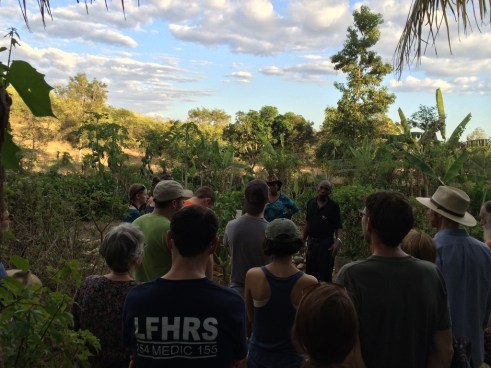
    We arrived at Port-au-Prince originally, then traveled 2 1/2 hours northeast to the Central Plateau, near the town of Hinche, where we were hosted by the Mouvman Peyizan Papay (the People’s Peasant Movement), led by Jean-Baptiste Chavannes. That’s him in the black shirt, showing us the gardens at the MPP compound.

    Chavannes is an agronomist by training who grew into a social justice leader. MPP’s vision, among other things, is to build self-sustaining eco-villages, and to lure back people who moved to Port-au-Prince over the past two decades. That, in short, is “repeasantization.”

    The tour ended with an amazingly candid talk about his—and Haiti’s—past, including his views on former President Jean-Bertrand Aristide (Chavannes said Aristide at one time called him brother but later was corrupted by power), the thought behind his movement, and his sometime difficult dealings with the government, including periods of exile and hiding and one time when he had 12 guns aimed at his head.

    It was an extraordinary afternoon.

    02-IMG_3108

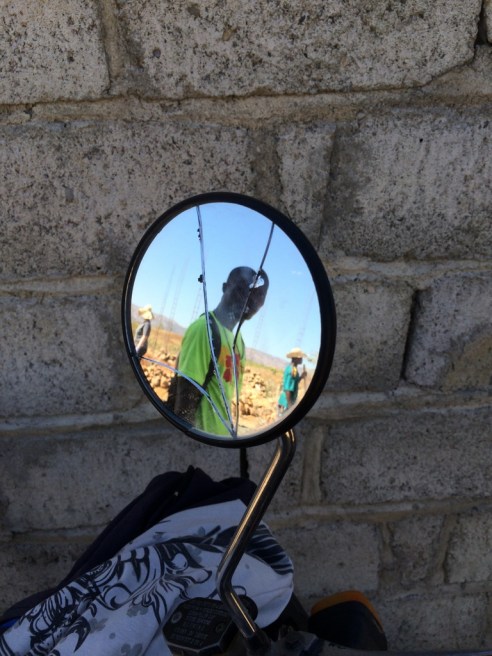
    I took this at our work site, where we were helping lay the foundation for 10 homes that will make up eco-village #5. I was taking a break in the shade of a storage building when I noticed the sideview mirror on a motorbike gave me a view on to the worksite.

    01-IMG_3169

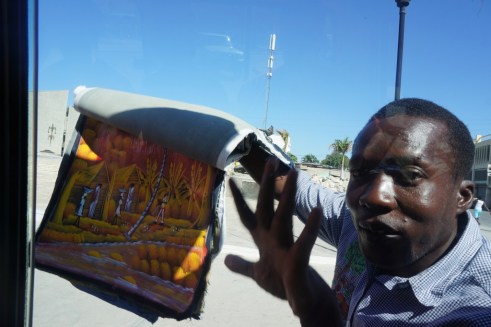
    I went to Haiti thinking I would go and try to meet people as much as possible as person-to-person. But that is just naive; there is no escaping the imbalances of wealth and privilege that bedevil an American visiting Haiti. This was less true when we were with MPP, as we created relationships that could supercede this sort of “default” framing. Just about every interaction we had outside of our MPP bubble ended up influenced by the fact of our American affluence. Traveling in the van was often another version of “the bubble,” largely because there was no relationship between those inside and those outside—but occasionally not, as when this gentleman popped up looking for a 5-spot for his painting on canvass.

    09-IMG_3345

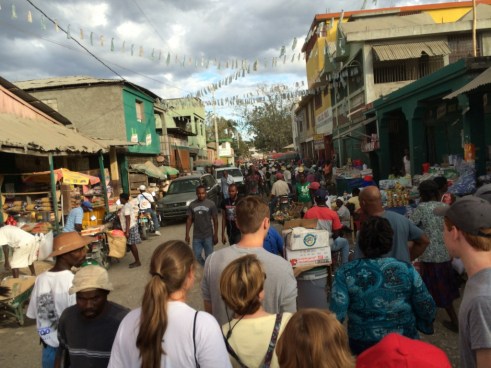
    The busy streets outside the market late on an afternoon in Hinche, in the Central Plateau.
    08-IMG_3344

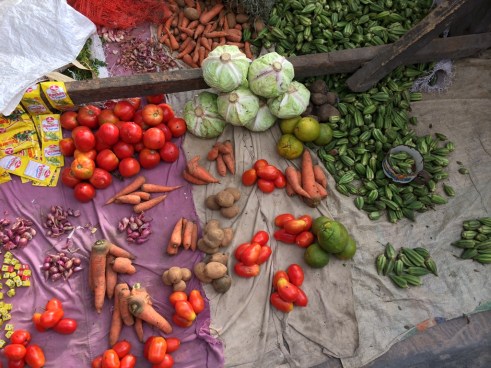
    You can find fresh fruits and veggies at the market. In the countryside, there was a fair amount of fresh food.

    07-IMG_3337

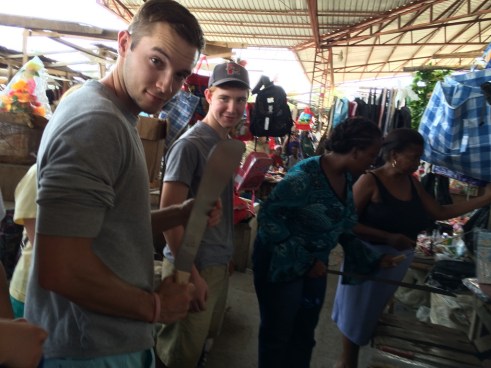
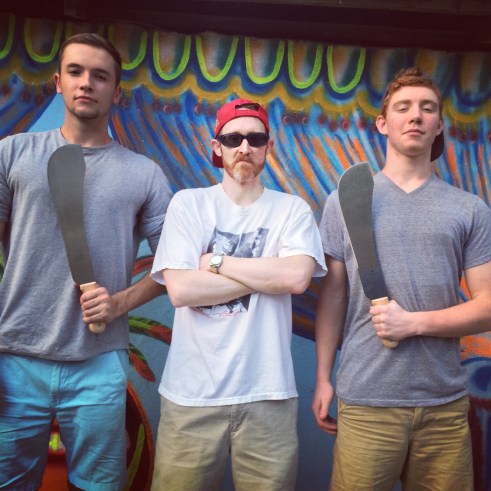
    Kelly and his new friend David both were fixated on getting machetes while in Haiti—in fact, they came up with a list of more than 100 things one can do with a machete (from harvesting papayas to shaving, they had it covered). Their collective wish was fulfilled in the Hinche market. For inquiring minds, the going rate for machetes—at least those sold to American suburban teens—is $5. These had very dull edges, so there was little danger of injury. Thankfully, there were no questions in customs.

    06-IMG_3334

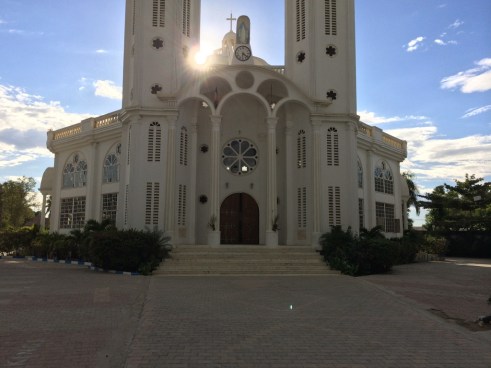
    The Catholic cathedral in Hinche. Pretty building, though the gates were locked on a weekday afternoon. About 80% of Haitians identify as Catholics.

    Processed with VSCOcam

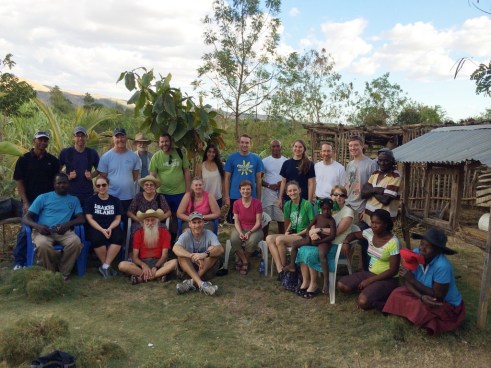
    We visited a young farmer who is also a member of MPP. That’s him, sitting to the left, front row. His name was Maccenje. He worked very hard, had more than three dozen tires he used as improvisational raised gardens (an MPP staple), and had planted trees throughout his property. Trees are a big issue in Haiti, as the land has been thoroughly denuded and the need for wood to cook far outstrips conservation and planting efforts. I sent this photo to Maccenje so he could post it on his Facebook page. I kid you not.
    04-IMG_3266

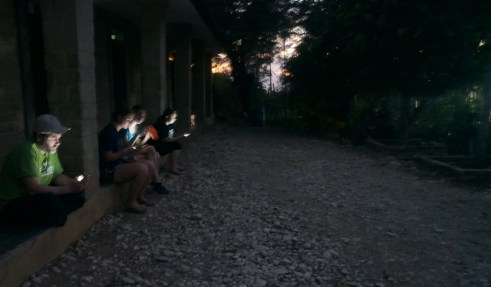
    There was wifi at one end of the compound, and there were ritual checkins throughout the day. This photo makes me wish I was a better photographer, to get the lighting a bit better. But you get the idea.

    13-IMG_3499

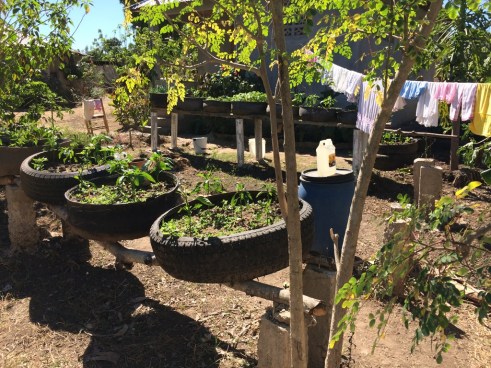
    These are tire gardens in eco-village #1, which we visited on our last full day in Haiti. I loved how green EV-1 was, with trees that afforded shade and an abundance of papayas. But the green-ness wasn’t the whole story. When we met with the 10 families that live there, they were interested in having more services nearby—especially health and education—and said the farming life was very hard.

    12-IMG_3396

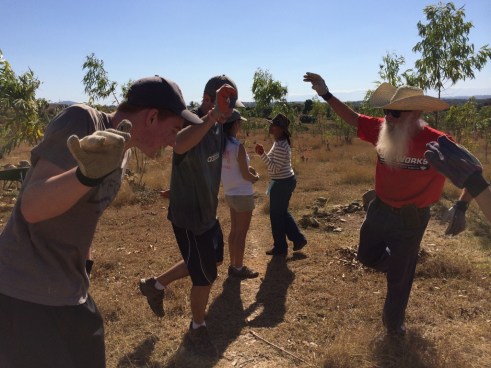
    The work sites were a lot of work, but folks had fun, too—dancing, singing, and fooling around. Here, two of our youth dance with team co-leader Mike Carpenter, of Main Line Unitarian Church.
    11-IMG_3390

    Sometimes the fun spilled outside the work site. I took this photo in Hinche, and the guy in the middle is minister Evan Keely, doing his best Caribbean island strong man imitation, complete with machete-wielding body guards. A little irreverence was a good tonic from time to time.

    10-IMG_3361

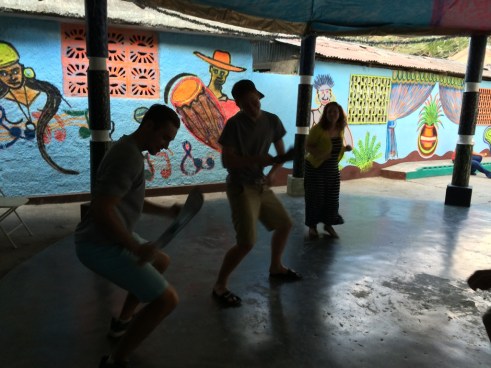
    The boys dancing with their machetes in a Hinche bar. They were largely alone on the dance floor, thankfully.

    16-IMG_3547

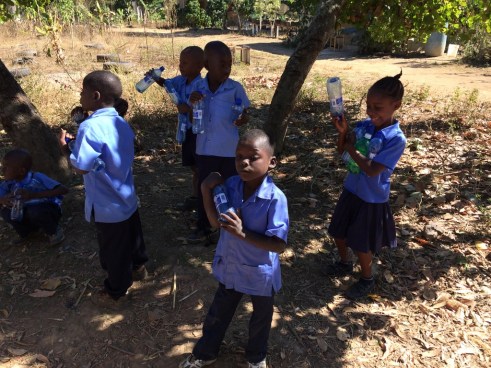
    These are the children of EV-1, who coveted our plastic water bottles as toys. They have sufficient water from a nearby well.

    15-IMG_3535

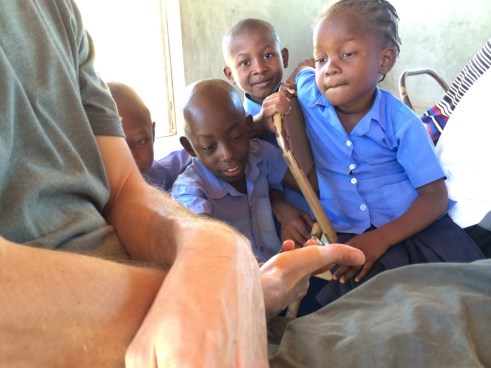
    Some more of the children. There are 32 of them in EV-1, among 10 families, and there were quite a few newborns. When we asked why one would choose to live in the eco-villages rather than in Port-au-Prince, the moms said it was safer in the countryside. They feared their kids being caught in a crossfire or assaulted back in P-au-P.

    14-IMG_3550

    We were walking through EV-1 when I looked down and saw a small toy Santa Claus that looked a lot like our team leader, Mike Carpenter. “Mike, they’ve got a doll of you here in Haiti!” Tell me I was wrong?

    That’s a start on my trip. More to come.

  • That’s bobsledder Steve Langton, who has a vertical leap of more than 62 inches—from a standing start. It looks like he’s messing with gravity. More about him—and his freakish ability—in this @MensHealthMag post.

  • The Practice of Practice

    You know, I used to laugh at this clip of Allen Iverson (see bottom). Iverson, one of the all-time gamers, explodes in a season-ending press conference when he’s asked about his—how to say this?—inconsistent practice habits.

    He says practice likes it’s a cuss word. He says it about 20 times in 142 seconds.

    “We’re talking about practice. Not the game that I die for, that I play every game like it’s my last. Not the game. We’re talking about practice, man. How silly is that?!?”

    Silly, I thought. But not in the way Allen meant it. I mean, he’s a professional basketball player. He is paid to play games, yes, but also to prepare with his teammates so they can perform optimally in stressful, competitive situations.

    Of course he needs to practice.

    But about a year ago, I had an uncomfortable realization.

    I was Allen Iverson.

    Because I needed practice, too.

    Not dribbling and shooting, though that wouldn’t hurt my once-a-week, lunchtime hoops game.

    I needed to practice listening. I needed to practice paying attention. I needed to practice being awake.

    I needed a practice.

    The realization was a tonic and a grace. Because practice isn’t so bad, no matter what “The Answer” said.

    In fact, I found, I liked practice. Taking a few moments each day to find my breath, to attend to my physical state and acknowledge the thoughts that race and loop and eddy, the ones that bruise and the ones that steal by without ruffling a feather. Taking a moment to open the circle of my awareness to include others. This is activity that makes my life richer, warmer, better.

    And it’s not work, which is my practice. In the same way Iverson disdained practice,  I hated the idea of non-employment work—as in, work at your marriage, or work on being a better parent/friend/church leader/brother/son/person. Why in the world would I want these relationships reduced to work. Isn’t it more than an employment?

    Anyway, I like practicing at marriage and friendship and being alive. That feels creative and iterative, open to opportunity. If you mess something up at practice, well, you just run through it again till you get it right.

    Practice opens up an intimacy with myself and, by extension, intimacy with others. Until I took the time to know myself more intimately, it was difficult to do the same for others.

    And that’s important at this time of year, when the world feels a bit like I’m standing atop a steep slope, my life on wheels, and the damn thing is trying to roll away down the hill. Between trying to close out the year at work (we all know, December is the shortest work month of the year), home (gift suggestions, photo books, hanging lights and propping up trees), and connect with friends, it’s a hard to find time to practice.

    Which is exactly when you need to do it.

  • Never Enough

    “Scarcity captures the mind.”

    That’s one of the key statements in a fascinating book I’ve been “reading” recently. (I’m never sure what to call what I’m doing when I listen to a book on Audible: “reading” or “listening” or “consuming”? I could use some guidance.)

    Scarcity: Why Having Too Little Means So Muchby Sendhil Mullainathan and Eldar Shafir, provides a sort of unified field theory of scarcity, one that explains the mechanism of scarcity across categories—from the physical (say, the poor, who lack essentials, and those who are comfortable but feel they are lacking the latest shiny thing, for example) to the temporal (anybody out there feel as if they don’t have enough time to do everything they expect of themselves?) to the relational (loneliness).

    Scarcity: Why Having Too Little Means So Muchby Sendhil Mullainathan and Eldar Shafir

    Sendhil and Eldar provide a couple useful concepts in understanding the captivity of our minds.

    Tunneling. Focusing on the item of scarcity. Dieters who can’t think about anything but food. Lonely folks who fixate on an upcoming date. Those without money on ways to get it.

    Bandwidth. The amount of mental resources available. In the most basic formulation, tunneling captures a portion of one’s bandwidth. Decisions made while distracted by tunneling tend to be worse than those made with one’s full attention. The argument here is that persistent scarcity is a headwind on all decision-making, a “tax” of sorts.

    Slack. A reserve of some type that lessens the scarcity mindset, alleviates tunneling, and preserves bandwidth.

    The authors are a behaviorial economist and a psychologist, and the book is well worth a read. It helped me to put some of my own behaviors and patterns in context, especially around “wanting mind,” and to better understand the decisions through a scarcity lens. As I ready for a service trip to Haiti, it served to remind me to listen closely to those I will meet rather than try to “fix” something or someone. For all of that, I’m grateful.

  • An Ice-Cold Bubble

    Very cool app, Bubbli, let me create a 360-degree “bubble” of my yard on this bitterly cold, blue-and-white day. See below:

    Snow Day (Bubbli)

  • New Tools for a New Year

    Used to be, in my teens and 20s, working out meant the gym and weights, the heavier the better.

    I still have a bench downstairs, but the amazing thing to me (now 48) is how little I use it—especially in conjunction with my barbell and weights.

    These days, when I use weights, they’re mostly dumb bells. And it’s not the “three sets of 10 reps” routine that grew, well, routine. Instead, I’m much more likely to be using:

    Bodyweight. Especially when doing a follow-along workout DVD, including Spartacus, SpeedShred, and 10-Minutes Torchers. Each one is chockfull of bodyweight exercises. Even when I’m doing something else, I will toss in 30 and 40 seconds of a bodyweight lunge or side plank. If you think bodyweight moves aren’t enough of a challenge, you haven’t tried the metabolic resistance routines developed by guys like David Jack and BJ Gaddour anytime recently.

    TRX. If you haven’t tried this strap-based system, it uses your own bodyweight and a variety of angles to create load, and is a creative, fun way to get in a full-body workout. I find TRX pretty easy on my lower back, as it encourages me to set my core and basically plank through whatever the movement. That’s a great cue for me to take care of my back. I also love doing pistol squats with TRX—it gave me the balance help I needed and allowed me to work single leg through a full range of motion. I felt the difference, in real life, immediately.

    Kettlebells. I’m still getting down my form—less arm, squeeze those glutes—but doing sets of 20 swings with 10 goblet squats and alternating sets of pullups and chinups is a killer workout that I’ve really enjoyed.

    The last thing I’ve done is shorten my workouts. While that sounds as if I’m doing less work, that’s not true. I’ve removed a lot of rest and keep the pace higher. I can get in an exhausting workout in 30-35 minutes, easy. That means I can sneak it in at work or at night without disrupting everything else I’m trying to get done.

  • Goodbye, Holidays (We Had Fun)

    From the Friday before Christmas to New Year’s Day, this holiday season has been eternal. That’s not bad, but it’s been looong. And for the sake of our waistlines, it’s time to move on.

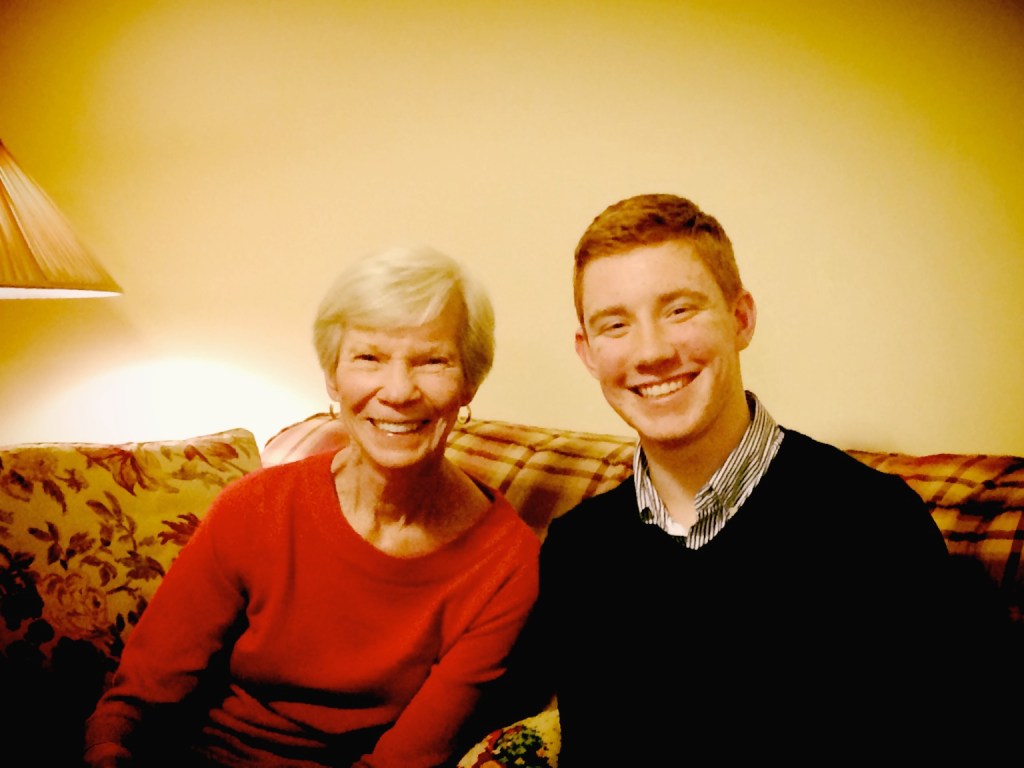
    So we’ll leave you with some photos (see below and above, where Kelly and my mom are together and looking good at Chris and Judy’s Christmas Eve get-together in the refurbished house) to look at while cooped up by the coming snows and cold.

  • Our 'Little' Christmas Party

    IMG_2711Virginia told me she wanted to invite a few people over before Christmas. She told me it wouldn’t be a lot of people, that nobody would accept our invitation.

    Well, she was wrong.

    Almost 40 people joined us for a very fun but not small at all holiday party on the Sunday before Christmas. It was a lot of fun and reminded me of several inscrutable laws of party hosting:

    • No matter how big your house, every person huddles in a 220-square-foot space and refuses to budge.
    • No matter how much wine you purchase for the party and how much wine everyone drinks, you will have more wine at the end than you did at the beginning.
  • The World Needs More Heroes (Thankfully, They Exist)

    I’ve been thinking a lot about heroes lately.

    This summer, my colleague Andrew Daniels pitched an idea to tell a story a day for a month. I liked the idea, and we tried to come up with a subject: what would be complex enough, evocative enough, and interesting enough to keep people engaged for 30-odd days.

    Thus was born Every Day Heroes.

    And a slight obsession with all things heroic.

    It started with the negative: Andrew pitching possible heroes and me shooting many of them down. It was completely a gut thing, which made me feel rotten. I don’t like giving people invisible targets and, frankly, it wastes a lot of time.

    So I began to pull together an Equation of Heroism. I went to Audible and found a recent, relevant and interesting book, What Makes a Hero: The Surprising Science of Selflessness, by Elizabeth Svoboda. On my Nexus tablet, I read what I thought was an unrelated book, Brene Brown’s The Gifts of Imperfection.

    What was surprising was Svoboda’s dissection of heroism started with compassion, and the Buddhist loving-kindness meditation. One who can’t see the humanity in others, and its reflection in one’s self, isn’t about to reach for the heroic. And Brown’s book made the point that true authenticity in our lives requires that we face up to it all—the joyful and the heart-breaking—and in that facing we can find our compassion for others, and ourselves.

    I began to articulate a definition of heroism. There were discrete elements: being of use to others, level of risk to the others, level of risk to yourself, how many people would benefit from the act, creativity in your “solution.” It led in time to an Equation for Heroism.

    So here goes. My equation runs like this …

    [Level of jeopardy] x [number of people at jeopardy]/2 (if more than 2) + [jeopardy to hero] x [ease or difficulty of heroic act] = heroic score

    I’d score the items on a scale from 1 to 5, with 1 being of little or no effect to 5 being the greatest possible. If you leaped into a pool full of crocodiles to save a baby, you got a “5” for “jeopardy to hero.” If you walked across your family room and took a lollipop out of a baby’s mouth, that’s a “1.”

    That helped. Andrew pitched a guy who had suffered grievous injuries in Iraq, losing a leg. He had recently separated from his wife, quit his job, and opened a CrossFit gym. Gutsy? Sure. Heroic? I didn’t think so. The equation told me he was acting to find himself, and while my heart was with him in his search, it’s not exactly heroic. I called candidates like him “eventual heroes.”

    The equation also helped me decide what kind of stories we should do and how many of certain categories: the guys who overcome a medical issue and raise money for a cause are heroes, but we don’t need too many of those stories. The obese guy who loses 150 pounds as a role model for and a gift to his kids? Sure, but again, a few of these in the course of a month go a long way.

    In working out a 31 heroes in 31 days conceit, I found the most compelling item in the equation was creativity, the person who imagines a fresh way of bringing the heroic impulse to bear. Ricky Smith, for example, who traveled the country doing random acts of kindness (#RAKE). The video we shot with him on a rainy day in New York City showed just how out of the norm a little kindness can be in the Big Apple—and how much our world needs some playfulnesss. (My favorite moment is when he offers an umbrella to a soaked young lady, who at first refuses it. “You can have it,” he says. “That’s why I bought it. It’s called niceness.”)

    Or Pittsburgh bikemaker Michael Brown, who agreed to do what others wouldn’t for fear of liability: make bikes for people missing limbs.

    Or car salesman Mark Rolands (talk about playing against type), who gave a kidney to a co-worker.

    And so it went for 31 days. People doing the right thing. Like Cleveland postman James Jones, who noticed a 92-year-old on his route wasn’t collecting his mail, and bugged the police till they checked and found him nearly dead in his home. He survived.

    “We’re the eyes and ears of our community,” Jones says, speaking for himself and his fellow mail carriers. “Every morning when we clock in, we gather around and discuss the importance of being safe and taking care of our customers. It’s our responsibility to look out for them.”

    But it’s not just the mail carriers. It’s all of us. We’re all heroes. And it gets to the heart of heroism—that we’re accountable to each other. That what we do matters. And that we can improve the lives of each other.

    So do it. And if you’re parent, make it part of your day to encourage the kids in your life to be heroes. If you want resources, there’s an amazing organization—the Heroic Imagination Project—that can help you to inspire the children in your life to be the heroes inside them.

    And while Men’s Health is done publishing a hero story a day, we’re not done with heroes. We’ll tell a couple of these stories each week. Coming soon: the Lancaster, Pa., teen who responded to an Amber Alert by tracking down and unnerving a potential pedophile until he released a 5-year-old girl. Talking with the young man made the hairs on the back of my neck stand up. Being in the presence of heroes will do that to you.

    It also makes the world seem simpler. Back to Rolands, who gave a kidney. Big decision. Must have involved a lot of sleepless nights.

    Uh, no.

    “I knew it was not only the right thing to do—but in this case, the only thing,” he says. “It’s such a great feeling to be able to help out a friend.”

    It’s simple. We all know folks who do it. We know we can do it as well. If only we’d start.

    So start. Perform an act of heroism today. You’ll feel better. Equally importantly, someone else will as well.