• #2: A Harrowing Day on the Roads

    Trip co-leader Mike Carpenter warned us at Tuesday night’s evening reflection that if something is going to go wrong during our time in Haiti, it’ll happen on Wednesday. He was right and wrong.

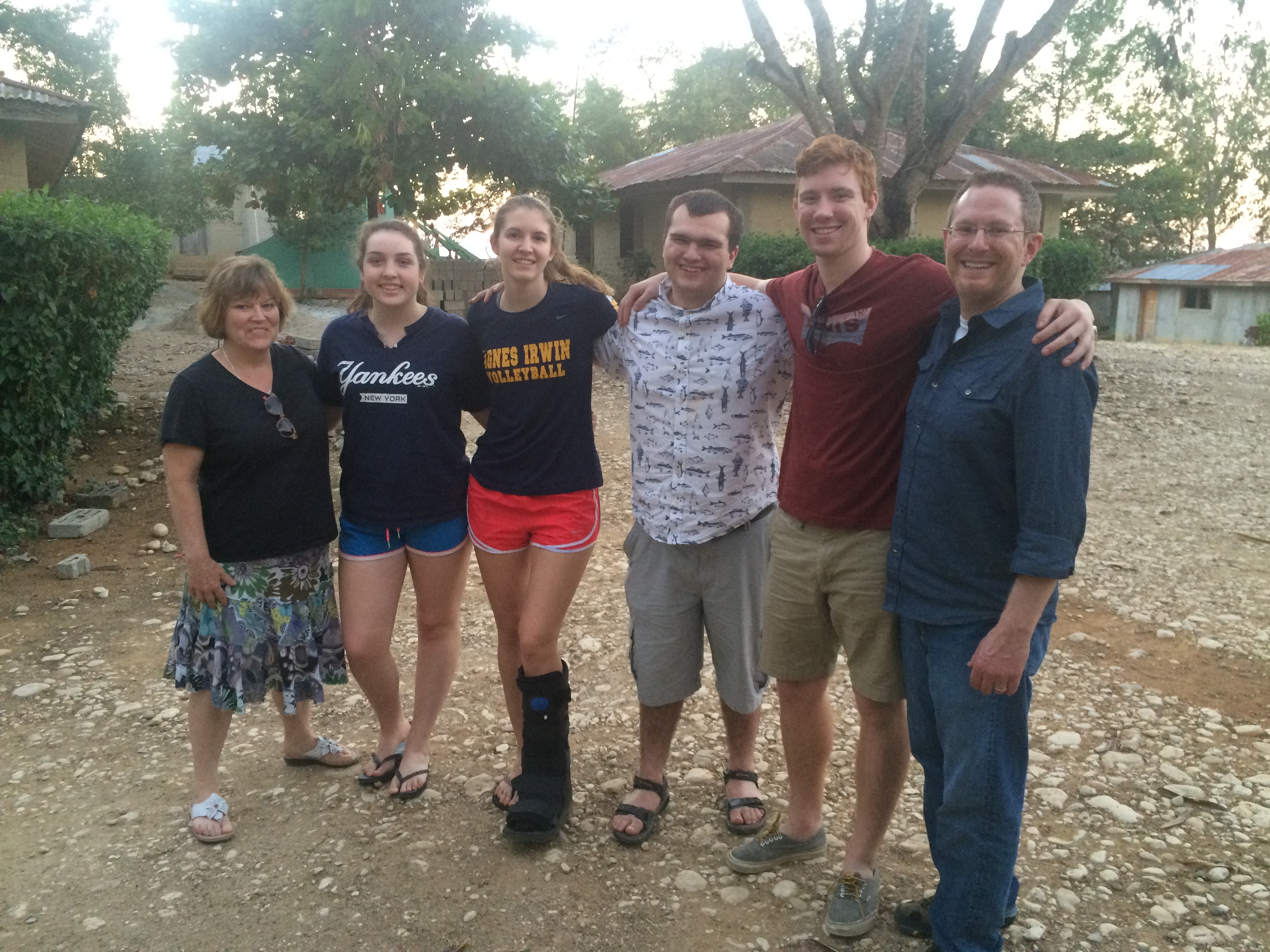
    The day started with a visit to MPP’s schoolhouse, which was expanded in the past year with a generous gift from the Unitarian Society of Germantown. We helped with the grounds and met the children, who were full of wonder, then headed to our vehicles.

    And that’s when Wednesday struck.

    This is the second of three posts about a service trip to Haiti Jan. 9-16, 2016.

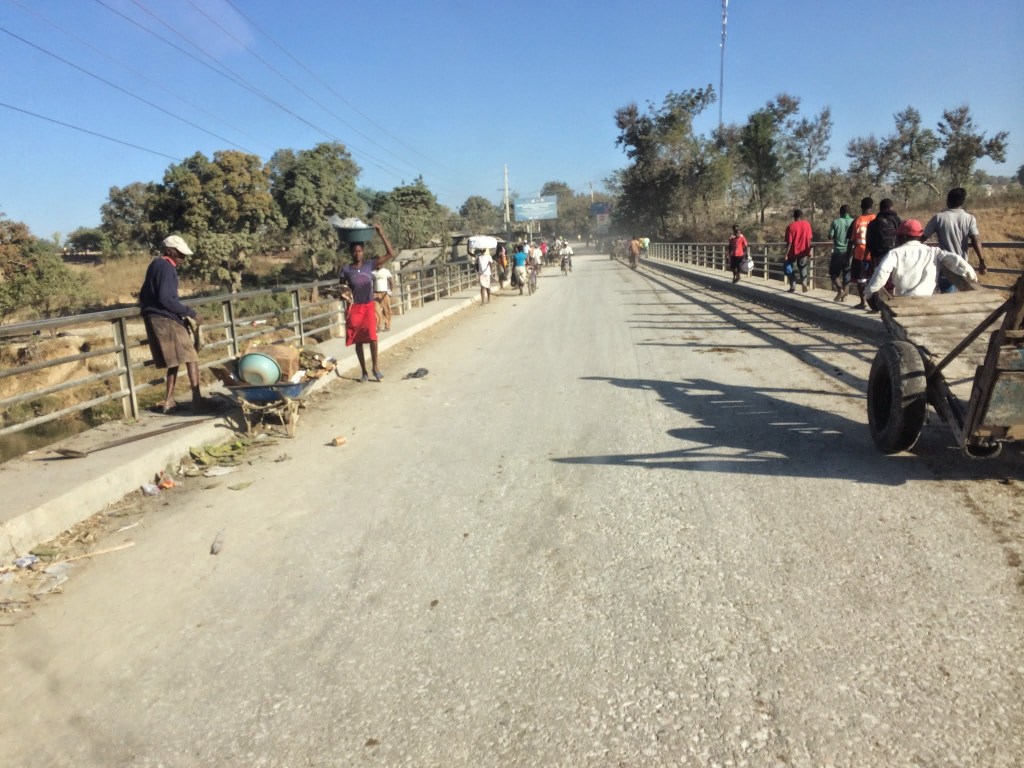
    On the road back, we came upon an accident. A motorbike with a passenger clipped a boy crossing the road. The boy was lying still where he fell, and the bike fell over too. One of the young men limped off the road.

    Our caravan stopped and two members of the group jumped out to aid the boy. Monica Perme and Nuala Carpenter are a nurse and retired physical therapist, respectively, and cared for the boy, while the boy’s father and others incited a loud, angry argument over who was to blame for the accident. The argument howled above the boy, Monica and Nuala.

    Amidst the furor, the boy regained consciousness.

    Eventually Monica, Nuala, the two injured Haitians and the boy’s mom went to the hospital in one vehicle, and the rest of us headed home in the other two.

    So often we ask ourselves why we’re in a place like Haiti. It’s not an easy question. Today we knew. We weren’t there intending to help in this situation; we were just there. We have no way of knowing if what we did prevented something worse, though it kind of felt like it did. What we do know is that at a terrible time in a young boy’s life, when he was surrounded by confusion, and anger, and noise, he received compassion and skilled care and he was delivered safely to more care.

    The reflection this evening centered on that event, and several other out-of-leftfield experiences that seem to happen more here than at home. And on the joy that comes with doing this work of living together.

    IMG_8622

    It included Monica remembering something that one of the youth, Julia MacDonald, said while gathering rocks to clear a space for a playground at the school what seemed like a lifetime earlier. Julia said, “I wish I had bigger hands to help.”

    May all of us have the hands and hearts to help, wherever and whenever we’re needed in this world that so often confounds our plans.

    #30

    Other posts from this 2016 trip:

    #1: A Whirlwind Start

    #3: Homecoming

    Our Trip in 59 Photos

    And from the 2014 trip, My Favorite 17 Photos from Haiti

  • #1: A Whirlwind Start to Haiti Trip

    We are settled in with our Haitian hosts after a whirlwind day and a half.

    The 13 members of the Unitarian Universalist College of Social Justice service learning trip to Haiti arrived in Port-au-Prince Friday and Saturday. Most of us are from the Main Line and Wellsprings congregations in suburban Philadelphia.

    This is the first of three posts about a service trip to Haiti Jan. 9-16, 2016.

    On Sunday after attending an evangelical Christian service, with more than 2,000 Haitians in the morning, we took a brief tour of the country’s national history museum. Then we climbed into three vehicles for the three-hour trip to the headquarters compound of the Papaye Peasant Mouvement (MPP), our hosts for the week.

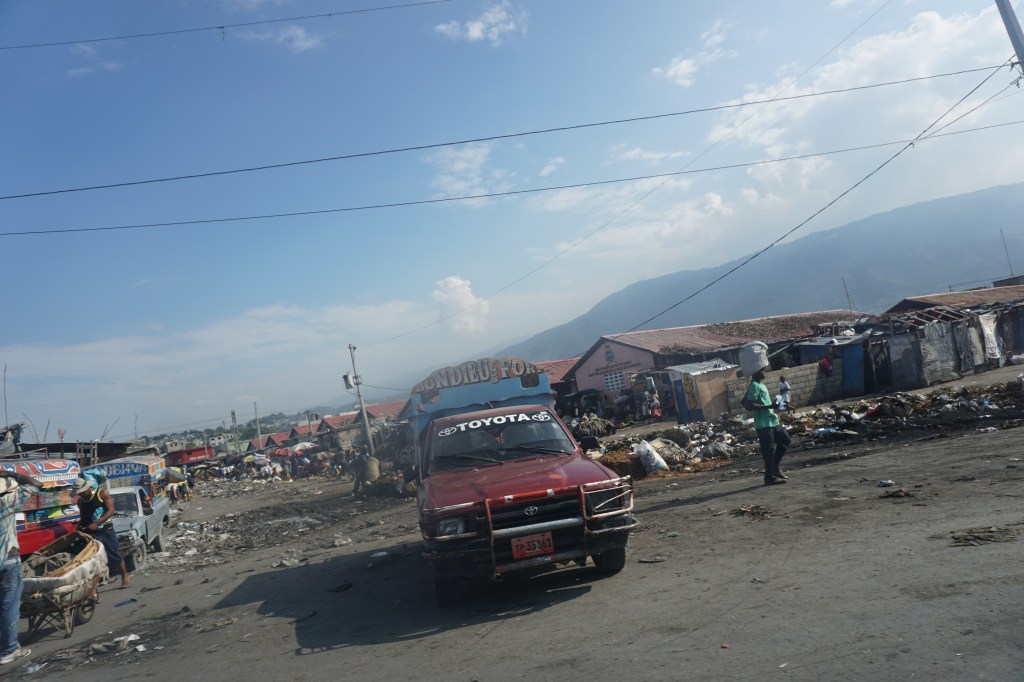
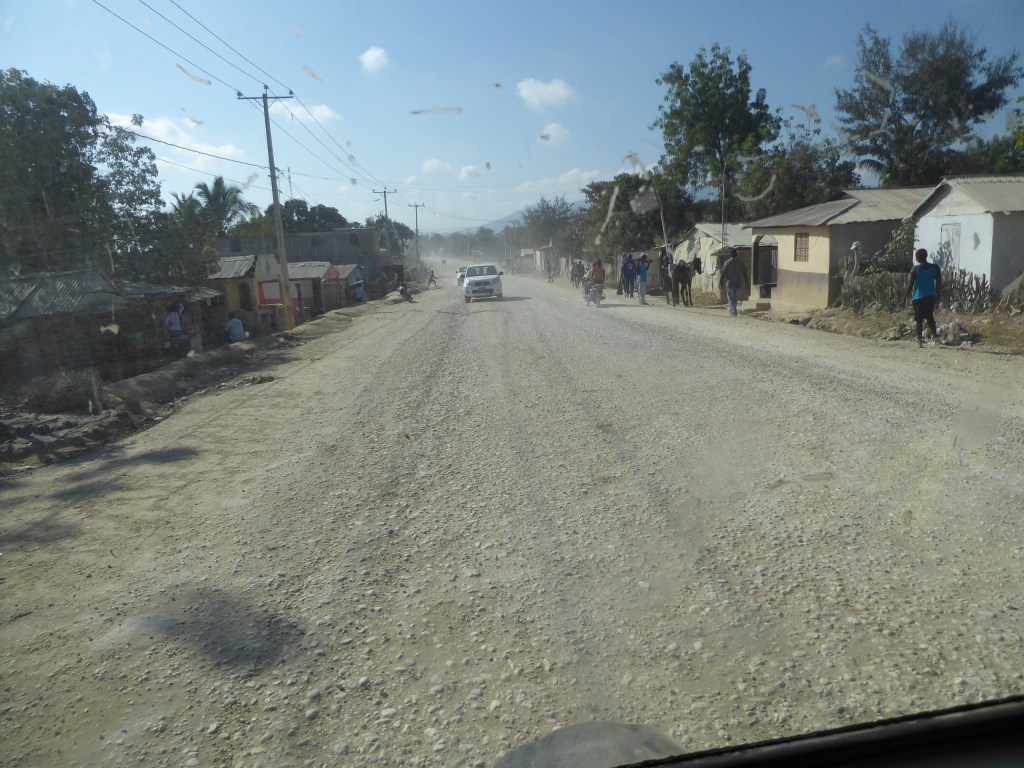
    The trip took us past a vast ghetto of makeshift housing near Port-au-Prince, through the mountains and into Haiti’s Central Plateau. To see the depth of poverty here, to be so close to the people who live their lives here, is a world-rocker.

    We shared our feeling of heart-opening and -breaking at the night’s reflection. A house away, we could hear a family going through its paces—talking, laughing, a child calling out. For me, it was a reminder that our circumstances may be so different, but our humanity is identical. We live, we dream, we fear, we grow angry and despair. We persevere.

    After the reflection, we star-gazed. The sky is both darker and brighter here, and bursting with light. May that be a good omen for seeing what is ordinarily hidden from us.

    Monday we will hear more from our hosts, hopefully including MPP’s founder, Jean-Baptiste Chabonnes, who recently abandoned a presidential  campaign. And we move one day closer to understanding and being in relationship with the people who live in this complicated, difficult, wondrous place.

    Please keep us, and our hosts, in your thoughts.

    IMG_8560.JPG

  • Christmas Time

    We started the holiday with a brunch for friends on Christmas Eve, went to New Jersey on the 25th, and ended up this weekend with the Kirks visiting us here in Pennsylvania. It’s been good to see everyone, and now it’ll be good to get back to a normal schedule and eating like normal human beings—before Kevin weighs 300 pounds.

    Some photos from the forthnight:

  • Parenting: A Haiku

    Kids can be lifeboats

    for parent’s aspirations.

    Careful, they can tip.

  • Why I Love This Pope

    Pope Francis’ powerful remarks after his trip to Africa strike me deeply:

    “Africa is a victim. Africa has always been exploited by other powers. From Africa, they came to America, sold as slaves. There are powers that only seek to take the great wealth of Africa … Africa is a martyr, a martyr of exploitation. Those who say that from Africa come all calamities and all wars perhaps don’t understand well the damage that certain forms of development do to humanity. It’s for this that I love Africa, because Africa has been a victim of other powers.”

    #Truth

  • Once Again, Trouble in Haiti

    I am headed back to Haiti in early 2016, with my youngest son and members of local Unitarian Universalist congregations—including my own, Wellsprings—so I have my eye on what’s going on there. And the news is not particularly good:

    I hope the country can hold fair elections and resolve the issues with its island neighbor—and that we can be assured of a safe trip in January.


  • My Wild and Precious Life at 50

    This is what I presented recently at Wellsprings Congregation as part of our annual Wild and Precious Life service, which draws inspiration from the Mary Oliver poem The Summer Day.

    It’s a little funny to be here as the representative for the 50s, as I’ve been 50 for 8 days now. But let me tell everyone, your 50s are great: you get a party every week!

    One of the last things I did in my 40s was talk to a bunch of middle schoolers. A friend had asked if she could volunteer me to speak about my day job as a journalist to the gifted program students. I was talking about the things you’d expect an editor to say. If you want to write, do 3 things: Read, write, be curious.

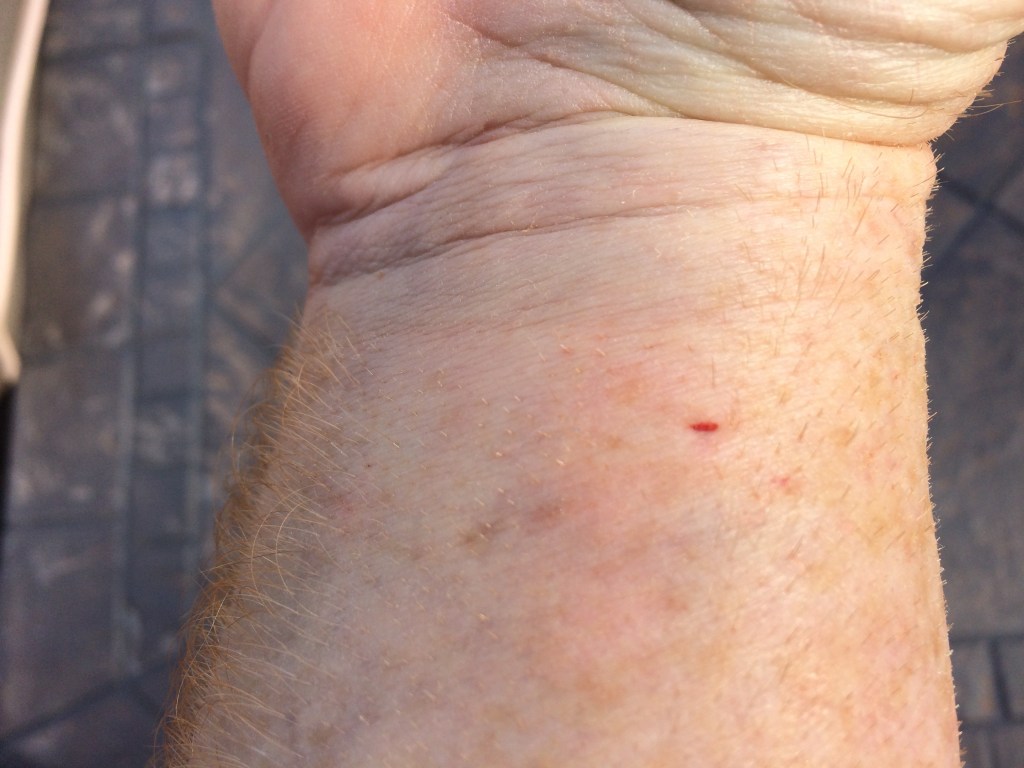
    Curiosity, my own and hopefully theirs, led me to share something I had no intention of sharing.  About 10 days before this, I’d had a surgery at Paoli Hospital where a surgeon performed a small miracle. He re-opened an artery in my heart that was more than 95% blocked. He did it through an incision in my right wrist that you’d have trouble inserting a cocktail straw through.

    The question I brought to that class was the one that had dogged me since this all happened: How am I still here? How do you live when precious little blood is reaching your heart through its biggest artery?

    One of the perks of being an editor for a magazine with “Health” in its name is I could ask doctors. And this is what they told me: I’m alive because life found a way.

    I didn’t find a way, at least the conscious part of me, which was conveniently ignoring the fact that I was getting slower when I ran and that I didn’t really know what my cholesterol and triglyceride numbers were because I hadn’t gone to the doctor in 6 years. I felt fine—that was the cloak I wore, and it fended off the nagging concerns of mid-life and the reality that my family has a long history of heart disease.

    Instead, my body laced together a network of capillaries that routed blood around the blockage and to my oxygen-hungry heart. The twin miracles of my body and medical science conspired to grant me a grace I hadn’t earned.

    As I start on my 6th decade, I find that this is the lesson. Life and love find a way.

    I’m reminded this week of my neighbors growing up. Herman and Mina were young and Jewish and lived in a small village in Poland. They knew each other a little bit, nothing more. When the Nazis invaded Poland at the start of World War II, they were sent to different work camps.

    After the war, Mina moved to New York City—something to remember today as we sort out the correct response to a new wave of refugees across the globe. Back then, it wasn’t ISIS but communism that America feared was sneaking across its borders. Anyway, Mina, she’s walking down the street one day, she sees a familiar face: Herman. He had moved to the same neighborhood. They dated, they got married, had kids, moved to the suburbs. They were waiting when my family moved in next door in 1972. My Mom and Mina grew close; they are on their fifth decade of arguing over who last bought milk for whom, and Mina calls my mom her Irish sister. At 91, Mina called me last week to wish me well on my 50th birthday. She wished me a life richer than hers.

    And to think, how unlikely was ― is! ― Mina’s life?

    But life and love find a way.

    I’m not a pollyanna. Tens of thousands of people die of heart disease each year. Sometimes life and love can’t find a way—they couldn’t hold the door open forever waiting for me to hear the call. But I did, just in time.  My doctor told me that something bad would have happened within the next 2 months without intervention.

    Millions didn’t escape the snare that Mina and Herman did.

    But it happens, and it happens more when you and I set our minds and hearts and hands to it, when we heed the call of our wild and precious lives.

    For me, that meant moving up a doctor’s appointment (not that difficult) and paying greater attention to my health going forward (same). It also means returning to Haiti this January, and sharing that journey with members of Wellsprings. Who knows what will happen? Rev. Ken might come back with a new way to grow tomatoes in his backyard garden next summer. A young Haitian may make a connection and his path might veer from its current course.  I might trip and turn an ankle that takes months to heal. Someone might meet the love, or the calling, of their lives.

    That is my prayer for all of us this morning.

  • The Sad Truth, Guys: Your 40s Suck

    When I turned 40, my mom pulled me aside and said, “The 40s were the best years of my life. Enjoy them.”

    I love my mom, and she has rarely led me astray—except about this. Because she was dead wrong. The 40s are not the best of times.

    Why would a usually optimistic and upbeat 49-year-old say this? Because it’s true (and I wrote this before my heart issue). If your life was an NFL season, your 40s would be a trap game. If it was a table game, it would be a sucker’s bet.

    It’s not so much that the 40s have the worst quality of life. All in all, I feel pretty good. And as I get older, I expect that health issues and chronic pain will make the day-to-day more difficult.

    But what is unique to the 40s is that if you’ve put care into your first two decades as an adult, you might enter your 40s positioned nicely: rewarding job, a growing nest egg, a durable and satisfying primary relationship, kids, the whole deal. You probably feel like you’ve got the world by the tail.

    But all those good things actually mean that you have an enormous amount at risk: all of these things are stressed for guys in their 40s:

    1. It’s unlikely that you’ll actually change your life station in a positive way. No matter how big a raise and promotion you get, you’re unlikely to escape the demons of your mortgage or of struggling for a way to put the kids through college. However, a career calamity is just an ogre-boss or a downturn in the business cycle away, and if you are let go to save costs, it’s unlikely you’ll hook back on anywhere near where you were previously (and out the nest-egg money that kept you afloat). And that’s for those who are relatively well-off. Researchers recently discovered that working-class white men (and women) in their 40s and 50s were in the midst of a historic, despairing rise in death rates.
    2. Also, guys in their 40s often get the urge to be their own bosses, to use their hard-won experience to strike out on their own. Sometimes it works out; often it doesn’t. Hence, the median age for bankruptcy filings is 45—even with health care increasingly stressing elderly, middle-class people.
    3. Busy guys can be lonely guys. Research shows that guys make up two-thirds of people who live alone in their 30s and 40s. Why is this important? Because the single-best determinant of longevity is number of friends beyond a spouse. When a woman’s husband dies, she spends more time with her friends. When a guy’s wife dies, he spends more time with himself. And that lack of connection is a literal killer in your 60s, 70s, and 80s.
    4. Physically, your 40s are when the weekly hurts go daily, when your hair thins to a point where you consider the comical comb-over your uncle employed (or maybe you just shave it all off). It’s when getting down becomes as hard as getting up. When your eyes go. It’s when skin cancer rates rise. Ditto for sexual dysfunction. You wouldn’t wish the 40s on your worst enemy.

    Add it up, and your 40s are the worst thing to happen to you since … since … since, well never. Because it’s always been better.

    Until, you know, your 50s. ;)

  • How I Had an Almost-Not-Quite Tragedy—and You Can Too

    Hi, I’m Kevin. I’m 49 years old, I’ve been married for 23 years. I have two boys in college. I’m 6-foot tall and weigh almost 190 pounds. I have worked for Men’s Health for the past 8 years and I generally live an active, healthy lifestyle.

    And five weeks ago a doctor unclogged an artery in my heart that might have left me dead or disabled before Christmas.

    “I’d say I dodged a bullet,” I told a friend, “but that implies that I saw it coming.” It’s more like I was standing one foot in the street when a city bus narrowly missed me.


    SEVEN WEEKS ago, I felt something in my chest. It was not quite pain, not quite pressure. Mostly an awareness, usually on the extreme left side of my chest. Sometimes it would jump to the extreme right side.

    Initially I thought I had tweaked a muscle while serving as part of a test panel for an upcoming fitness DVD (Oh, the perks of being a Men’s Health editor).

    Six weeks ago, the something hadn’t gone away, and I had to admit that it wasn’t a muscle tweak. The discomfort was coming from within my chest—like those floor-drops-out-below-you moments in a horror movie where the police let you know that the maniac’s call was placed from INSIDE your house!!!

    The realization came upon me like a dark cloud (cliched, but exactly how I felt). My family has a long history of heart disease. My dad had quintle-bypass surgery in 1985, at the age of 44. Even worse, when he awoke from the procedure, his surgeon asked him when he had his heart attack. My dad stared at him dumbfounded. He had never had a heart attack, he insisted. The surgeon said the scar tissue around his heart argued otherwise. That set off a family parlor game: When Did Dad Have His Heart Attack? We finally landed on a most likely candidate: Family vacation, a few years earlier. The San Diego Zoo. He thought he was coming down with the flu and headed back to the hotel, where he slept it off. He was back in the driver’s seat, driving us to LA, the next day. Call it drive-thru rehab. That was my dad. He passed away five years ago, at 70.

    His dad died at the age of 42, in 1944. An Irish immigrant driving a bakery truck, he flipped it over on the streets of New York. They pulled his dead body from the truck. Nobody did autopsies on poor Irish truck drivers back then, so the cause of his death remains a medical mystery.

    It’s pretty much like that on my dad’s side of the family. His cousin, in Dublin, has suffered from painful angina for years, and has enough stents to open a cardiac medical supply store.

    And still, I figured that if I did enough good things—stayed active, ate pretty well, managed stress and my weight—that I could stay ahead of this shadow. But here it was.

    I called my GP, let’s call him Doctor V, and asked to move up a scheduled checkup by a week.


    Things were going fine at my checkup. My blood pressure was a little high but that was understandable because I was nervous. I bent over a table, grimaced, and found out second-hand (pun intended) that my prostate was a small, supple thing of beauty. Dr. V and I talked about my chest discomfort and he thought it sounded muscular. Lauren the Nurse would come and give me an EKG and I could go home.

    Except that, after taking the EKG and disappearing for a second, Lauren came back and asked me to stick around. Dr. V. wanted to talk with me.

    The shadow closed in.

    t_wave_inversion

    Here’s a quick primer from EKG 101: In a healthy EKG, there are a series of waves, labeled P through U. P marks the contraction of the atria, and is a slight turn upward; QRS is a small down-big up-small down movement that marks the contraction of the ventricle; and the T is a small upward movement that marks the re-set (repolarization) of the heart before it pumps again. The P, R, and S are all supposed to go up. In mine, several of the leads showed the first two waves going up, then the third sagging downward. That’s an inverted T wave, and the T stands for Trouble. It can be a sign of blockage.

    But maybe not. My doc wasn’t sure what to do. We didn’t have a history together. In fact, this was our first time as doctor and patient (we knew each other from his treating my 18-year-old son). EKGs are not exact science, he explained. In fact, I could have had this abnormality in my heart beat since I was born. “My gut tells me this isn’t something we should ignore,” he said. “Would you mind going to the ER?”

    I didn’t, and I did. The docs drew blood to check for specific inflammation markers and to run a blood panel, and did another EKG. The decision: I wasn’t having a heart attack but I needed more tests, specifically a nuclear stress test.


    SIX DAYS LATER, I woke up the morning of the stress test feeling better than I had in two weeks. No pain at all. A ghostly absence of sensation.

    The stress test involved injecting a radioactive dye in my bloodstream, then imaging my heart before and after a period of activity. It was pretty cool—I’d been experiencing this long enough that my curiosity was now routinely trumping my fear—and strangely liberating. The ER doc had made a point of telling me not to go too hard until that test, especially after I told her I had pushed a sled with 425 pounds on it around the gym trying to trigger a reaction that would confirm this was angina (it didn’t work). So the chance to exert myself on a treadmill felt good. I was able to walk fast, then run, for about 9 minutes. I got my heart to 160 beats per minute. No pain. Maybe this is going to be OK, I thought. I laid down for the after-exercise set of images and went home.

    My brand-new cardiologist, Dr. Matthew Levy, called me on my cell that evening. I was shooting baskets on my driveway.

    “It doesn’t look good,” he said. “You definitely have a blockage. I need you to come in two days from now to get cathed. We’ll take a look at it, and if the blockage is severe enough, we’ll perform an angioplasty.”

    We talked for a few more minutes, then he said. “I don’t know you very well, but you don’t sound surprised.”

    I was, and I wasn’t.


    TWO MORNINGS later, I was on an operating room table in Paoli, Pa., the object of a cardiac catheterization. I was drugged but not knocked out; it was more dreamy than blotto. While I know that I was half-there, I have no useful memories from the operation or from the couple hours afterward.
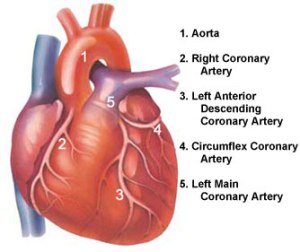
    coronary_arteriesI would later find out that my left anterior descending artery (known in heart circles as “the widowmaker”), which snakes down the front of my heart, was about 95% blocked. A stent was put in place to open the blockage. I was out of the hospital within 24 hours of the procedure, with little to show for it other than a broken night’s sleep and a minuscule incision in my right wrist, where the catheter was inserted. The site was a little swollen and bruised. I sat outside on the deck of a local winery at 4 p.m. that day, sipping a half-glass of red wine, enjoying the afternoon sun, listening to a jazz band, and insisting to friends that I had indeed been a patient in a hospital that morning.

    I have a new regimen of three pills—baby aspirin, the blood thinner Effient, and the statin Lipitor—that I take daily. I’ve run a few times and the biggest issue has been my balky left knee. I am about a minute-a-mile faster than I’ve been for the past two years. I wonder if having an almost catastrophic blockage of the biggest artery feeding my heart is actually an advantage. Am I now turbo-charged? Am I asking for some karmic fuck-job for even thinking this way??

    My cardiologist tells me I was days, or weeks, or maybe a month or two from a possibly devastating heart attack.

    I feel pretty damn lucky.


    THE QUESTION, of course, is this: Shouldn’t I have seen this coming?

    Medically, the answer is surprisingly equivocal.

    How to treat folks like me remains controversial, said Dr. Spencer Nadolsky, the medical editor of Examine.com who has a practice in Olney, Md.

    “It really depends,” he said, “because someone with a low risk—a slightly elevated cholesterol level but not a family history, they’re clean, their blood pressure and blood sugar is all fine—they can have slightly higher lipid levels without as much of a risk as someone with those risk factors. You may have to treat 100 people like that to avoid one heart attack over five years.

    “Now someone with higher risk, you may be treating 50 or less people to prevent one heart attack in five years. It is one of those things we argue all the time. It’s primary prevention vs. secondary prevention.

    “What you’re doing now is secondary prevention. You’ve already had a coronary issue and now you’re trying to prevent the second event, a heart attack. And other people who have initially high cholesterol [but no cardiac disease] may be on statins too. What we find is that statins may be more helpful in secondary prevention than in primary prevention.”

    So there’s a medical argument that makes me look less like an idiot. Yes, I had a family history, but my blood panels over the years were borderline. Cholesterol right around the 200 mark, with not a lot of the good stuff (HdL). Triglycerides on the high side, but not crazy. Over the years, a doctor would look at the panel, then look up at me, then decide it all bore watchful waiting.
    ldl-target-no-CAD

    ldl-target-w-cad

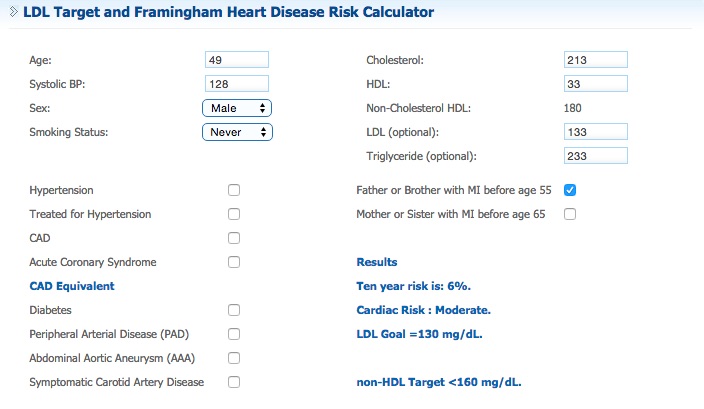
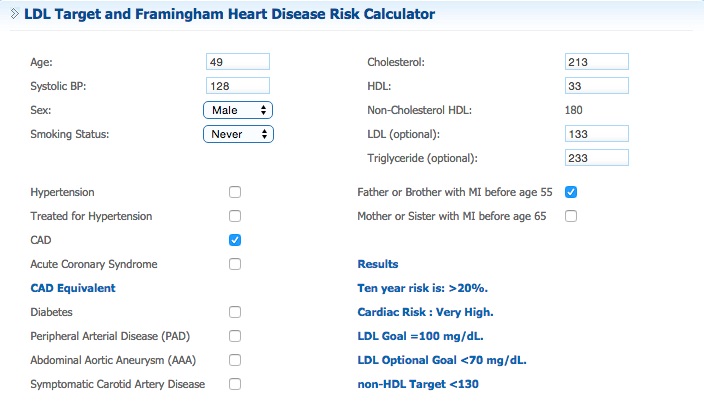
    Here is a recent blood panel and a popular risk calculator. If I don’t know I have cardiac artery disease, my 10-year risk of heart attack is  6%. It jumps to more than 20% if I do know. Note that I copped to a family history in both examples.

    So we watched—until I screwed up. And here’s where we move beyond medical cover into my own accountability. Because I stopped seeing my old GP after we disagreed over how much activity a guy in his 40s should engage in (I said more, he thought it was asking for injuries). He moved out of the area soon after—and for 6 years or so, nobody watched anything.

    It’s the most obvious advice one could receive: Find a new GP. But I didn’t. I can say I was busy, that I was occupied by family and career and anything that could keep me from going to the doctor. That I felt fine.

    But the truth is as long as I was feeling good I didn’t want anyone spoiling my party. So I didn’t look while I stepped in and out of that city street.

    Anyone else? Show of hands, please. Thought so. We’re a big club, with a lot of turnover. in 2012, more than one-quarter of all guys avoided a checkup with a doctor.

    Late this summer, with my 50th birthday just months away, I decided to find a doctor. I made an appointment with a general practitioner who impressed me with his care of my son, who has several health issues. I set up the appointment before I ever felt a twinge in my chest. In my blacker moments, after my chest tingled and before I got to the doctor’s office, I thought, Nice job, Kevin. You invoked this motherfucker.

    Except I know I didn’t. And that my decision to move up my checkup may have saved my life.

    So here I am, and here’s what I’m doing.

    I’M CLEANING UP MY DIET. I love salty snacks and good ol’ Coca-Cola. Both are getting dialed WAY DOWN. The great thing about cravings is the longer you go without them, the easier it is in the moment. My Coke intake is down to about one a week. Pretzels, once a month.

    Dr. P.K. Shah, of Cedars-Sinai Hospital in Los Angeles and a member of the Men’s Health advisory board, encouraged me to lean toward a Mediterranean Diet. My cardiologist, Dr. Levy, made it even simpler: eat fish twice a week. Dr. Nadolsky said to snack on nuts and find a way to consume 4 teaspoons of extra virgin olive oil every day.

    Since this episode began, I’ve dropped 6 pounds, to 182. I’d like to settle in for now close to 180 pounds.

    I’M MOVING. Research says that 30 minutes of moderate exercise 4-5 times a week is where I should start, and I am. But there’s some that suggests that more intensive exercise provides additional benefit. My doctors have told me I’m under no restrictions within reason. My aim is to push myself hard to keep my pipes as clean as possible. I am pushing the sled again, and running suicides at a local basketball court. Suicides suck—but not doing them sucks worse, I think.

    I’M RECONNECTING WITH THE DOCTOR. I’ve learned my lesson. I will continue to check in with my GP (Dr. Graham Vigliotta) and cardiologist (Dr. Matthew Levy, Cardiology Consultants of Philadelphia).

    The thing is, your 40s are a time of transition and not all of it is positive. Risks accumulate over time, and I cannot ignore them. I am taking statins—with coronary disease now determined, that’s a no-brainer, says Dr. Nadolsky.

    If any of this story resonates with you, start at the beginning. If you don’t have a GP, get one. If you haven’t seen yours in a while, see her or him. If you have a family history of heart disease, get a baseline EKG by 40, younger if you have other risks factors (obesity, hypertension, generally shitty habits).

    At the same time, and I hope this doesn’t sound like I’m backing out here, I refuse to be defined by my illness. I am not a diagnosis. Going forward, my goal is to be aware of it AND work with it to thrive.

    I’m hanging my hat on what Dr. Shah told me: “Although having heart disease at a young age indicates a serious predisposition, proper lifestyle and medical management can largely control that risk and is compatible with a normal life span.”

    “People with conditions like yours live into their hundreds,” said my new best friend, Dr. Nadolsky.

    I’M STAYING POSITIVE.  People who have coronary disease who have a positive attitude tend to stick with behaviors that provide better outcomes, like exercise and compliance in taking meds,  reports a study in Psychosomatic Medicine.

    Beyond that seemingly self-evident bit of news, I have a fresh new frame: I’m on a journey from happily ignorant to scared shitless to soberly, joyously aware. I know that I was extraordinarily lucky. A very-real and long-unacknowledged peril never turned into a calamity.  I know people right now who weren’t cut such a break.

    One thing I’ve done is apologize to my wife for letting this all skulk in the shadows long enough that she needed to wait an hour for me to return from a hospital cardiac cath operating theater. Just before I headed in, she looked down with her eyes brimming, and said, “You know you mean the world to me.”

    I know, and I know that I am part of a lot of people’s worlds. I will be a better steward of her care, and their care, going forward.

    I’M TREATING MY LIFE AS A GIFT. I’m sharing this with the intention that it helps me (and you) live in awareness of the shadows and the light of our experience.
  • Kevin's (Almost) 50th Surprise Party

    About 30 friends and family members snuck up on the house and surprised Kevin a week before his 50th birthday, when he thought three couples were going over for a dinner party. Virginia told everyone to bring beer and balloons. We are now swimming in both. So if you like either, come on by!

  • 1-IMG_7435

    About 5 years ago, my mom made the offhand comment to Pete that she would take him to Las Vegas for his 21st birthday.

    Five years later, she was good to her word. This is the two of them in the lounge of the hotel/resort/casino Aria.

    The two of them spent four nights in Vegas before she headed home and he headed to San Francisco to visit his friend Zack Moore.

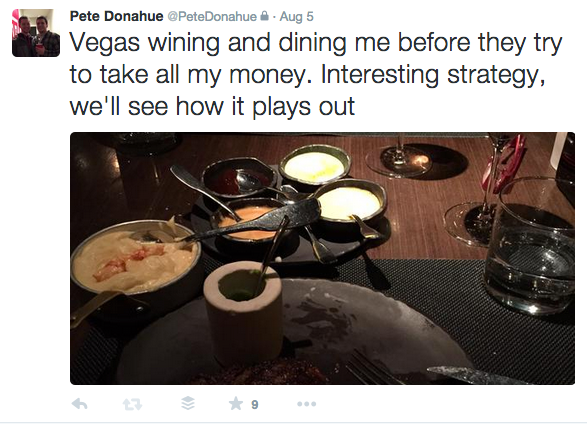
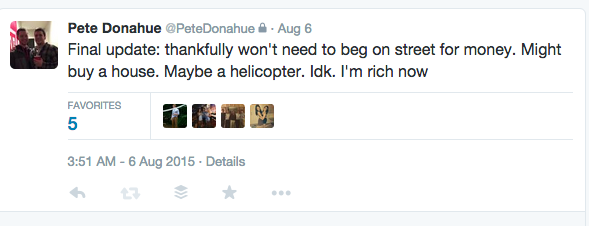
    Pete told me he didn’t have much money to his name after working a minimum wage internship this summer, but somehow he managed to find enough money to play table games. From his Twitter account it sounds as if it started badly.

    pete-wine-dine-twitter

    before a late rally.

    pete-winning-twitter

    My retirement plans hope he’s right.

    Oh, here’s his photo from the Marin Highlands looking back through the Golden gate to San Francisco (with a little photo editing by me).

    1-IMG_7445

  • A Father-Son Talk With Jason Isbell

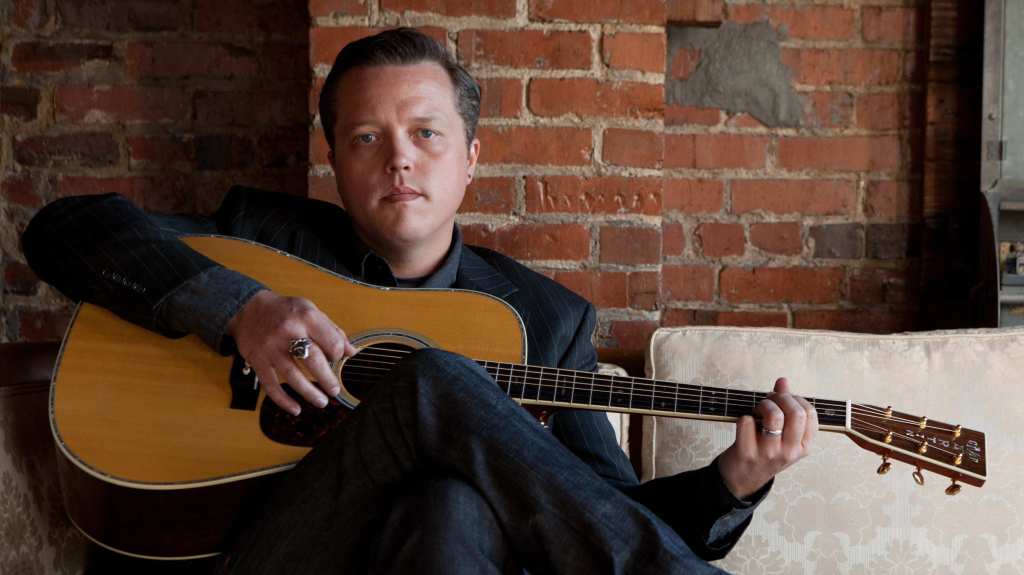
    Jason Isbell is my favorite singer/songwriter. Has been for about two years now, since the release of his album Southeastern. So I was super-excited to have a chance to speak with him last month for an article about Father’s Day, fathers and sons. Isbell has a song in which he recounts the advice his dad gave him as the 21-year-old Isbell set off on the road with the hard-livin’ band Drive-By Truckers. (Here’s a very funny story about the song.)

    The discussion morphed into a lot of other directions, including what saved his life and why he thinks checklists are a bad idea. Here is a transcript of our discussion, with my parts paraphrased (sorry, I didn’t need it for the article, so I didn’t transcribe my parts).

    What happened when you shared “Outfit” with your dad for the first time?

    I was probably 21 or 22, and it was one of the first songs I’d written after I’d first gone on the road with the Drive-By Truckers. It would have been late 2001 or early 2002. I brought a guitar on over and sat down and played it for him. I believe that’s what happened. Probably because we didn’t have a recording of it. You know, he liked it a lot. He has a good sense of humor and he understands what parts of that song are serious and what parts aren’t. And even the parts that aren’t are in tribute to the kind of person he is.

    He’s a good listener, so he knew exactly what I was talking about when I sang it for him.

    (more…)